


DUBAI, 28th August, 2026 (WAM) — Mohammad Abdullah Al Gergawi, Minister of Cabinet Affairs and Chairman of the World Governments Summit, affirmed that strengthening frameworks for cooperation between governments and international organisations, and advancing partnerships that reinforce their positive role in shaping the future, are central to the World Governments Summit’s vision.
He emphasised that this is a key objective the Summit seeks to achieve in partnership with governments, organisations, leaders, experts, and decision-makers around the world.
Addressing the dialogue of the World Governments Summit that brought together seven candidates for the position of Secretary-General of the United Nations, Mohammad Al Gergawi said that the World Governments Summit is committed to fostering international dialogue and providing a platform for exchanging ideas and perspectives, as well as sharing expertise and experiences. This commitment stems from the Summit’s mission to promote cooperation in driving positive change, improving people’s lives, anticipating the future, and developing partnerships centered on people and focused on the future.
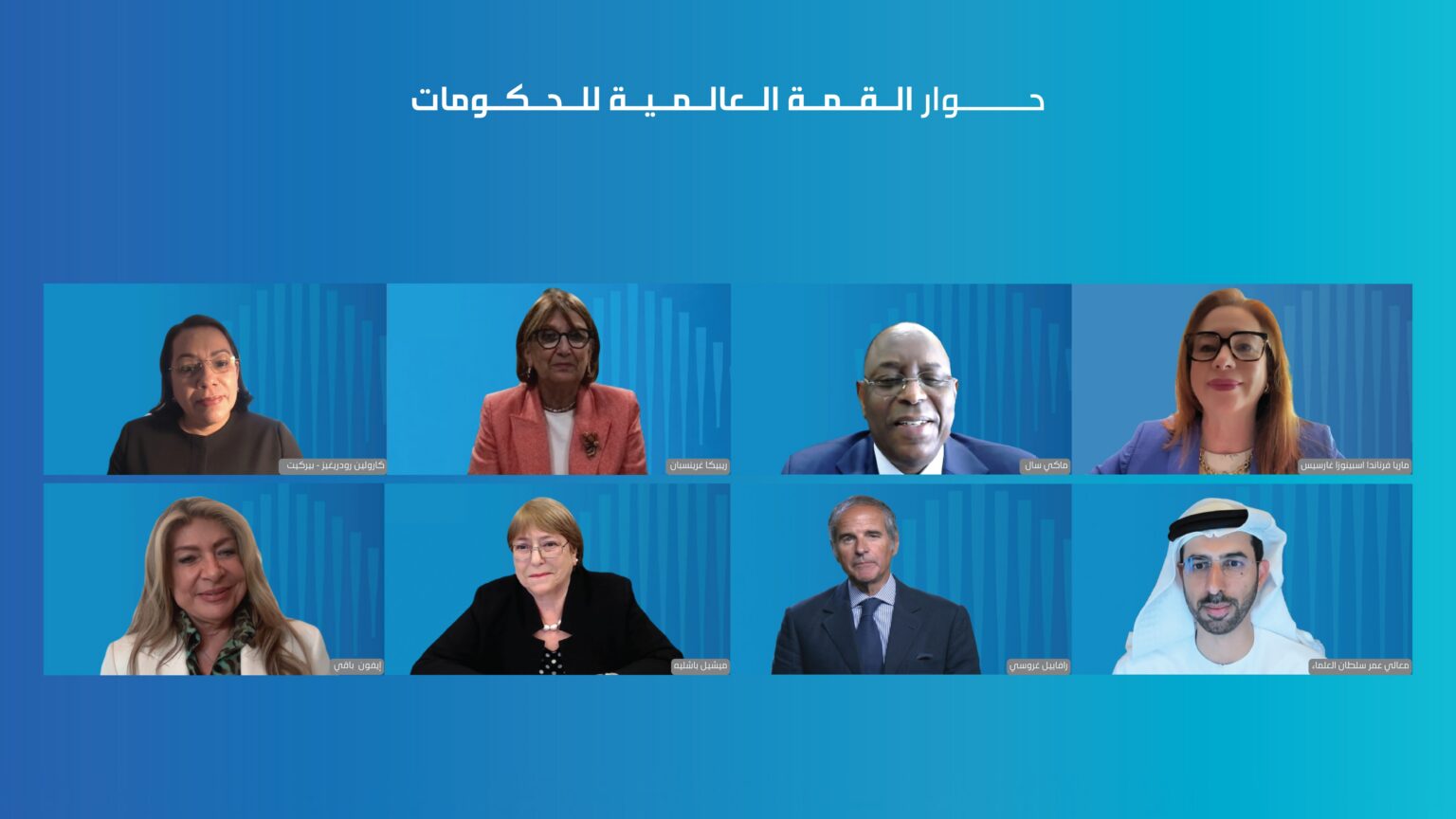
The dialogue brought together 7 candidates for the position of United Nations Secretary-General, including former presidents, international officials, and ambassadors. They presented their perspectives and ideas on the future of global leadership, the new opportunities created by accelerating technological development, and the major challenges facing the international system and governments across various areas of development.
The discussion took place as part of the World Governments Summit Dialogue – The Future of Global Leadership, organised virtually by the World Governments Summit Organisation through its specialised platforms aimed at expanding international dialogue and strengthening efforts to anticipate the future of sectors most closely connected to people’s lives.
Participants in the dialogue included Omar Sultan Al Olama, Minister of State for Artificial Intelligence and Vice Chair of the World Governments Summit; Macky Sall, Former President of the Republic of Senegal; Michelle Bachelet, Former President of the Republic of Chile; Rafael Mariano Grossi, Director General of the International Atomic Energy Agency; María Fernanda Espinosa, President of the 73rd Session of the United Nations General Assembly; Carolyn Rodrigues-Birkett, Permanent Representative of the Republic of Guyana to the United Nations; Rebeca Grynspan, Secretary-General of the United Nations Conference on Trade and Development (UNCTAD); and Ivonne A-Baki, Former Ambassador of the Republic of Ecuador to the State of Qatar, the Republic of France, and the United States of America.
Omar Sultan Al Olama affirmed that the rapid changes the world is experiencing, and the unprecedented challenges they pose to leaders of governments and international organisations, require redefining concepts of leadership and designing new models that are more proactive and future-ready.
He noted that, through its specialised dialogues, the World Governments Summit continues to provide an open platform for anticipating the future, sharing perspectives and expertise, and strengthening positive cooperation aimed at shaping the future.
He said that the dialogue focused on the solutions and tools available to governments to build future readiness, ways to strengthen their ability to achieve the best results, develop opportunities, and address challenges, the role of leadership in a rapidly changing world, the role of artificial intelligence in shaping the future, and ways to harness it to advance development efforts and improve quality of life.
The Dialogue, examined the future of global leadership and the changing role of governments and international institutions in addressing global transformations and challenges in the next phase. It also reviewed the set of enablers and capabilities that will determine governments’ ability to maintain their effectiveness.
Across its sessions, the dialogue addressed a number of themes, including the importance of foresight and future readiness for governments; the importance of governments’ ability to achieve results and execute effectively; the role of governments in transforming development into real opportunities; mechanisms to strengthen governments’ resilience in the face of major challenges; the challenges and opportunities of artificial intelligence and its role in advancing development; mechanisms to ensure its governance and development in ways that positively impact governments and societies; the role of the United Nations in shaping rules and ethics for the use and development of artificial intelligence; the future relationship between governments, international organisations, and major technology companies leading the technology race; and the importance of developing frameworks for cooperation among them within an effective, clearly defined partnership ecosystem.
Carolyn Rodrigues-Birkett emphasised the importance of reforming the United Nations, saying, “The voices on reform have never been louder, and we have all agreed in the UN that it is time for reform.” She noted that there is no alternative to the United Nations, that it can be reformed, and that the role of the Secretary-General centers on building bridges between Member States and with regional organisations, global companies, and institutions.
She emphasised the need for a UN Secretary-General focused on peace and security, ending conflicts, advancing the Sustainable Development Goals through stronger financing and partnerships, and safeguarding human rights through stability and development.
Rebeca Grynspan affirmed, “Multipolarity is not a choice; it is a fact. What is a choice is multilateralism. Multipolarity without multilateralism will lead us towards fragmentation.” She stressed that what is required is restoring the role of the United Nations in achieving security and peace and advancing development.
She stressed that effective diplomacy requires UN reform centered on stronger partnerships, closer cooperation with regional and local organizations, greater trust with Member States, and balance across peace and security, development, and human rights. She also called for lowering the cost of capital and strengthening multilateral financing for development projects in the Global South.
Macky Sall said, “There can be no peace in persistent poverty. Development must become a true peace strategy.” He noted that the international system is fragmented because trust is weak, and affirmed that the highest priority for the United Nations Secretary-General is to build bridges of trust and communication with all stakeholders to bring viewpoints closer together and achieve the required consensus.
He emphasised that the United Nations remains the indispensable framework for collective action and global dialogue, but must become more effective, agile, and capable of responding to rising geopolitical tensions and global challenges.
María Espinosa affirmed, “Real reform has to be assessed by how many lives the UN has saved, how many children it has protected, how many conflicts it has prevented. This requires a new business model for the UN that we can build together.” She noted that, eighty years after the founding of the United Nations, the time has come for a woman to lead the organisation.
She stressed that, despite a crisis of trust, the United Nations remains essential as the only global platform giving all countries a voice. Restoring its effectiveness requires continued institutional reform, and a stronger culture of trust within the international system.
Ivonne A-Baki affirmed: “If in 2031 people could say that the United Nations learned to prevent human suffering rather than simply respond to it, I would say it was worth it.” She stressed that the world is at a defining moment in which we need a United Nations that acts rather than reacts.
She noted that global power increasingly extends beyond governments to major technology companies, requiring stronger cooperation, transparency, regulation, and corporate responsibility. She called for a more agile and proactive United Nations focused on prevention, results, and sustained partnerships.
For her part, Michelle Bachelet said, “We should not defend multilateralism simply because it is the system we inherited. We must renew it, so it can anticipate rather than react, listen before deciding, and deliver results that people can see in their lives.” She added that the world needs a United Nations that unites everyone, moving beyond managing the present to shaping the future by adopting an approach focused on prevention and proactivity in preventing conflicts and building trust with Member States, organisations, and companies.
She affirmed that the major challenges facing the world today require strengthening the multilateral international system so that it becomes more representative, fair, and effective, and that the United Nations’ approach must focus on impact, results, and prevention by developing a flexible and effective system to prevent conflict, strengthen diplomacy, enhance partnerships, and remain close to communities.
Rafael Grossi said, “This debate on the future of our global leadership must approach the role of international institutions with eyes wide open… Not being afraid of recognising that change is needed.”
He added that the conflicts and fragmentation affecting the international system, and the protracted conflicts that have continued over recent years, coincide with major challenges in health, energy, the environment, climate, and food. This requires a United Nations that embraces and strengthens multilateralism, partnerships, and cooperation. He noted that there is a gap between the current reality of the United Nations and what is expected of it, and that this gap must be bridged through a clear institutional approach to resolving conflicts.
It is worth noting that the World Governments Summit represents a global platform for anticipating the future and a space for specialised international dialogues across various vital sectors, through which it seeks to shape the features of the next generation of governments.
The Summit focuses on analysing future trends, global challenges, opportunities, and on showcasing the latest innovations and best solutions to inspire government innovation in addressing future challenges.
Source: Emirates News Agency
