


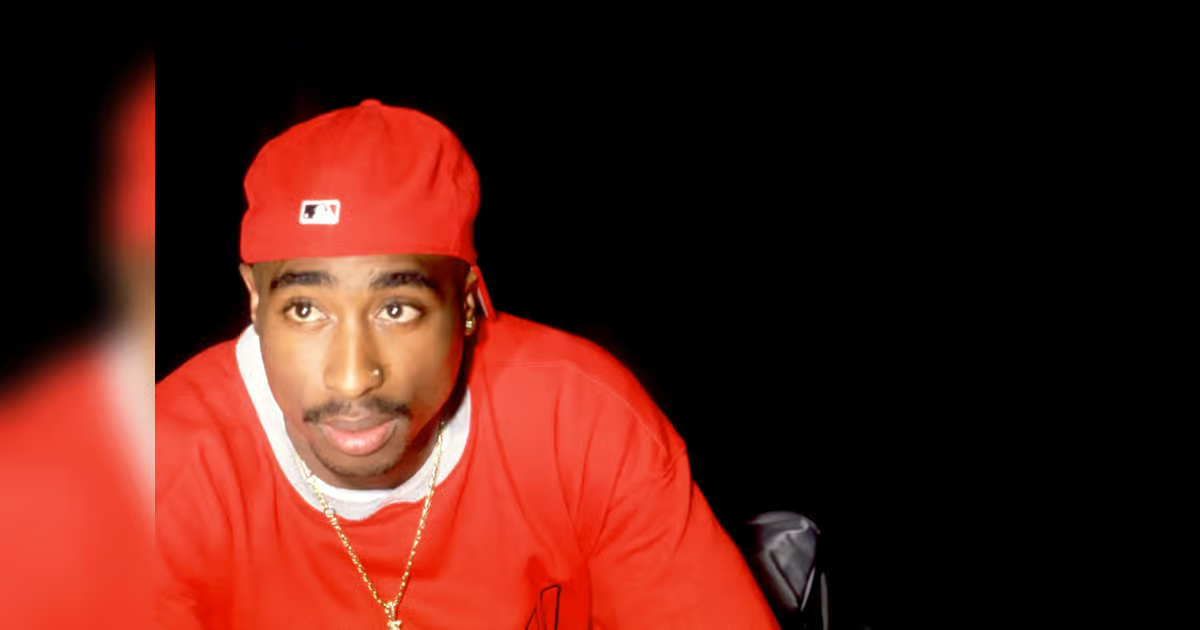
For many years, it seemed that the murder of Tupac Shakur, in a drive-by shooting near the Las Vegas Strip in 1996, might never result in a suspect’s arrest, let alone a conviction.
The police had theories about the assailants but lacked evidence. The white Cadillac that carried the shooter was never recovered. Neither was the gun.
As the years passed, “Who shot Tupac?” became shorthand for an unsolvable mystery.
But on Monday — a week shy of 30 years since the shooting — a jury in Las Vegas convicted a former member of the South Side Compton Crips of orchestrating a crime that turned Shakur into a pop cultural martyr and changed the trajectory of hip-hop.
The guilty verdict, which could send the defendant, Duane Keith Davis, 63, to prison for life, was a moment of catharsis for many of those who knew Shakur. Some members of the rapper’s family released a statement saying they were “elated and relieved”.
“It does feel like a little justice,” said Paul Stewart, a music producer who worked closely with Shakur on the soundtrack to Poetic Justice, the film that gave the rapper one of his first starring roles. “Maybe late, but it’s a little justice for Pac’s family and for the memory of one of our great icons of American music history.”
For others who were close to Shakur, though, a long-delayed verdict did not bring the closure they desired. In a trial that relied largely on Davis’ own account of the shooting — shared in a memoir as well as in interviews with police officers and documentary filmmakers — there were no revelations in evidence; there was no proverbial smoking gun. Both of the men in the Cadillac who have been accused over the years of pulling the trigger are dead.
“My appetite for justice has not been fed,” William Garland, Shakur’s father, said Tuesday in a brief phone interview.
Garland, who was absent for most of Shakur’s life and lost a legal dispute with the rapper’s mother over his estate after his death, followed the trial closely. He criticised the prosecution on social media, saying it lacked key evidence and relied too heavily on the words of a defendant with a reputation of being unreliable.
“This information has been out there for years and years; why now?” Garland said.
As the law enforcement investigation into Shakur’s death ground to a standstill, conspiracy theorists and true-crime documentarians picked up the mantle. But the answer to “Who shot Tupac?” is still not universally agreed upon.
Davis has previously identified the shooter as his nephew Orlando Anderson, a fellow member of the Crips who, amid a gang feud, was publicly beaten by Shakur and his entourage of Bloods the night of the shooting. But other accounts suggest it was Deandrae Smith, another passenger in the white Cadillac. Anderson was killed in a gang-related shooting in 1998, and Smith died in 2004 of natural causes.
The only man alive who would know as much as Davis about the moment when shots rang out on September 7, 1996, is Marion Knight, the record label impresario known as Suge. He was in the driver’s seat beside Shakur. But Knight, who is in prison for a fatal hit-and-run in 2015, never had an appetite for talking to the police about that night.
Some who were close to Shakur surrendered to the uncertainty long ago.
“Only God knows what really happened; we can only speculate,” said Anthony Criss, the lead rapper of the hip-hop group Naughty by Nature, who was close with Shakur.
Although he said he believed it was a rightful conviction, he did not necessarily feel relief, viewing the trial as having forced Shakur’s family and friends to relive the pain they have felt over his death.
Only six months after Shakur’s death, his friend turned rival, Christopher Wallace (known as The Notorious B.I.G., or Biggie Smalls), was gunned down in Los Angeles. Speculation swirled that it was another act of retaliation in the feud between Knight’s Death Row Records and Sean Combs’ Bad Boy Records.
The murders of two hip-hop titans based out of opposite coasts forced the hypercompetitive world of rap to confront the devastating consequences of its rivalries. Gangster rap started to be replaced by a slicker subgenre dominated by figures like Combs, now in luxury suits.
It was the decision by authorities in Los Angeles to reopen Wallace’s murder case in 2006 that, ironically, led to the conviction in the Shakur case.
Eager to learn what Davis knew about Wallace’s killing, authorities built a drug case against him, which put pressure on him to share information that might allow him to avoid charges. He told them he knew nothing about Wallace’s killing but something about Shakur’s.
In a conversation with the police in 2008, Davis said that more than a decade earlier, he obtained a .40-caliber Glock pistol and pursued Shakur and Knight, finding them stopped at a traffic light. He shared the information under a proffer agreement, which meant that authorities could not use it to charge him.
But in 2011, after one of the detectives present for that interview, Greg Kading, had left the force, he published a book based on surreptitiously recorded audio of that conversation, publicly pointing a finger at Davis for the first time.
Law enforcement initially believed that its hands were tied. In an interview Tuesday, Kading said he’d had little confidence that the case would end up in court until Davis began speaking openly to documentarians and podcasters.
“It gave a renewed hope that maybe this is a prosecutable case,” he said. “And that’s exactly what happened. It just took a long time. They say that the wheels of justice turn slowly, and by God, sometimes they do.”
After Davis was indicted in 2023, he disavowed his public accounts of the shooting, saying he had invented a story to make money on the hip-hop media circuit. He has maintained his innocence.
In a memoir published this year, Mopreme Shakur, one of the rapper’s brothers, recounted the agonising aftermath of the shooting. He said that his devastation was mixed with anger at the police for an investigation that was falling short. The family took solace in the idea that his music would keep part of him alive.
“My justice would be having my brother back,” he said in a television interview during the trial. “Other than that, I’m really at a loss to describe exactly what justice is.”
This article originally appeared in The New York Times
Source: Khaleej Times
