


What happens when 177 people laugh out loud together in a black-box theatre? This weekend, we found out.
As Mumbai-based theatre company D for Drama brought Puraane Chawal to Dubai’s The Junction on September 26 and 27, there was something profoundly powerful about sitting in a room full of strangers and hearing laughter echo through it. One person gives in, then another, until suddenly an entire room is responding to the same moment at precisely the same time.
There is nothing quite like live performance. And I suspect it will only become more important as we attempt to retain and preserve the collective human experience in an age increasingly mediated by our clever little friend called artificial intelligence. So much of what we consume today is tailored to what an algorithm thinks we want, reinforcing the boundaries of what we already “know”, “like” or “choose” to see. Theatre asks something entirely different of us. You have to show up. The actors have to show up. And for a few hours, everyone agrees to inhabit the same world together.
And what a world Puraane Chawal gave us.
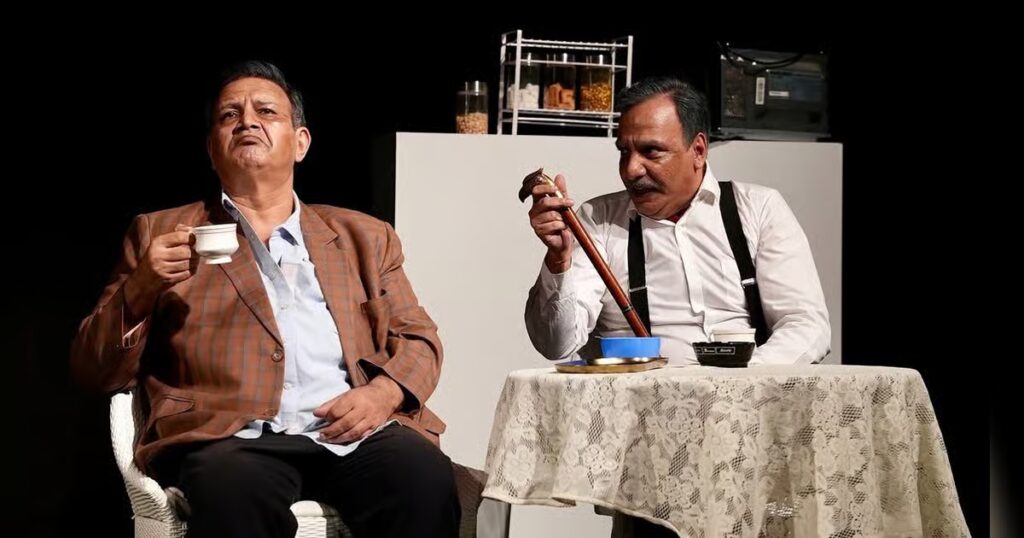
Directed by actor-director Sumeet Vyas, the two-act tragicomedy adapts Neil Simon’s 1972 play The Sunshine Boys for contemporary Mumbai, where Khushaal Mehendi (Kumud Mishra), one half of a once-celebrated comedy duo, now lives alone. His days have shrunk to a recliner he holds dear, a worn-out television set and weekly visits from his nephew-turned-manager Vicky, played by Ghanshyam Lalsa, all while Mehendi clings to the belief that show business might still come calling.
Then, it does. A lucrative opportunity to recreate one of the duo’s old sketches means Mehendi must reunite with Vijay Das, or VD (Shubhrajyoti Barat), the man he performed alongside for 42 years before their partnership collapsed. The stage that once bound them together becomes the unlikely place where two men, separated by years of resentment, are forced to confront everything they have refused to say.
The premise gives Mishra and Barat ample room for comedy, but it’s what they find beneath it that makes the performances so affecting.
Audiences may recognise Mishra from films such as Rockstar and Article 15, but what he brings to the stage feels entirely different. His Mehendi is an extraordinary alchemy of wounded pride and an almost childlike longing to be loved.
He wears solitude as though he has chosen it, until the possibility of his old companion returning exposes just how fragile that independence really is. It’s there in the smallest details: the sulking face, the staunch retorts, the stubborn silences and the bitterness that seems to curdle every time VD’s name enters the conversation. Mishra never asks you to pity Mehendi. Instead, he allows the loneliness to leak through the cracks of his pride.
Barat, familiar to screen audiences from Mirzapur, is almost unrecognisable as VD. His performance lives as much in the body as it does in the dialogue. There’s the measured pacing, the shrinking twitch of an eye, the tremor of a hand and the physical hesitations of a man whose body has begun to betray the vitality still alive within him. Each detail deepens the authenticity until you almost forget there’s an actor constructing it before you.
Together, the two take us into the entangled, bruised lives of these ageing comedians and refuse to let us out, held there by the sheer conviction with which they inhabit them. Their comic timing is exquisite, but perhaps more moving is the sense of history they create between two people: the shorthand (or shall we say, the probing finger!) for irritation, the utter disdain, the instinctive familiarity that can only belong to those who have known each other for far too long.
And perhaps the title itself carries another meaning by the end. Puraane chawal, an idiom used for seasoned old hands who know every trick in the book, could just as easily describe Mishra and Barat themselves. These are, after all, two puraane chawal of Hindi theatre, and watching them command a stage is a reminder that experience does not diminish with age.
For Dubai, where Hindi-language theatre is still carving out a larger space alongside the city’s international performing-arts scene, productions of this calibre arriving from Mumbai matter. And the minutes-long standing ovation that followed felt like an affirmation of that appetite.
The unvarnished reality of ageing is one none of us particularly wants to wake up to, no matter what stage of life we are in. But if we must confront it, perhaps there are few better ways than through two artistes who transform its weight into belly-aching laughter and an irrepressible zest for living.
Somehow, in their hands, the inevitable feels a little less daunting. And when 177 people can laugh at that inevitability together, perhaps a little easier to embrace.
Source: Khaleej Times
