


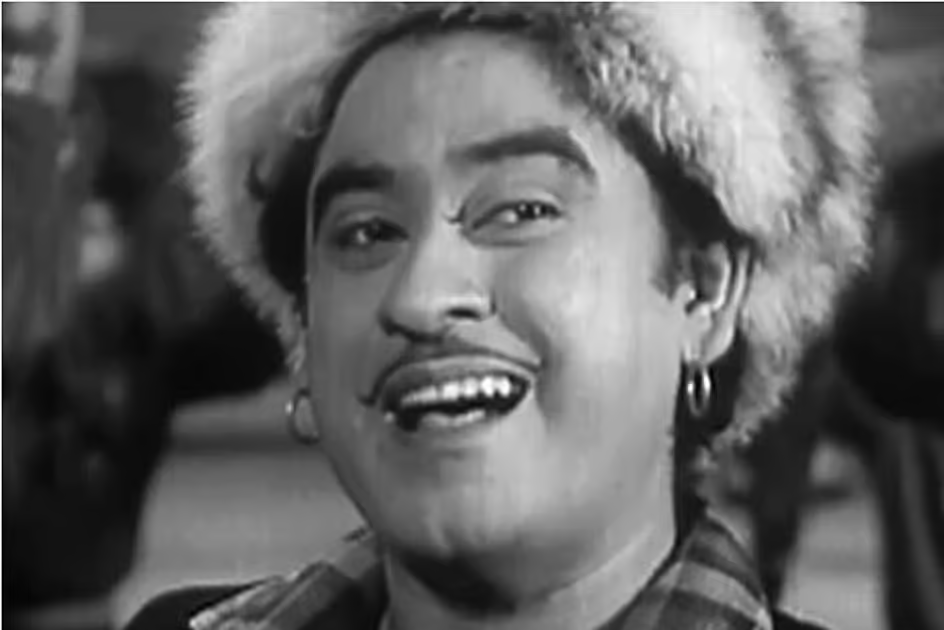
Dr Johann Werth, a professor from Frankfurt, was once on his way to the Indian Institute of Science, Bangalore for a guest lecture when he heard a yodel emanating from the car’s music system. Although he could not decipher the subsequent lyrics, he could fathom that his ears have come across something special. Noting down the details from the cab driver, he turned to the Internet to frantically get acquainted with the voice. This drove him to enrol himself for an online Hindi course for he wanted to feel the voice wrapped around the lyrics. To a fly on the wall, it had to be a moment to remember. For, it is not every day an Indian singer inspires a German to learn ‘ka kha ga’. Forty years after kicking the bucket, Kishore Kumar continued inspiring without any bias for language, region, borders and religion. And that included hostile and adversary nations.
During the shooting of Door Ka Raahi at the borders, Kishore Kumar once had to belt out some of his most famous numbers to satiate the demand of the Pakistani Army, while unwittingly crossing the prohibited area. These and some other massive cultural footprints he left behind in Pakistan have inspired a generation of music lovers, classical and contemporary musicians to search for his expressive melodies and cemented his legacy as a unifying cultural icon across South Asia.
For this most outrageous inhabitant of the Hindi film industry, no wonder the craze is only increasing each passing day after his death. Research studies on his enduring legacy show that 76.9 per cent of contemporary Indian artists acknowledge him as a direct inspiration, while 84.6 per cent of audiences believe his music successfully creates an obstacle to a generational gap.
Last heard, his “Mere Mehboob Qayamat Hogi“ was rampaging with 530 million youtube view. Right from WhatsApp uncles to Gen-Z creators, everyone has been in awe of his raw and unpretentious emotional honesty in his tracks. As a composer, his ratio of hits to total songs composed must be one of the highest in the world. For someone who did all this merely by pure observations and without any formal training, calling him a phenomenon or a genius would be an understatement.
His audience extended beyond the ordinary. Childhood friend Ramnik Bhai Mehta reminisced on his unrivalled talent, “We were returning from school and on the way back, he would choose a spot on the meadow near the playground and in the midst of an enchanting sunset glow, would suddenly burst into his musical phrases. An antelope used to graze around and on hearing young Kishore sing, suddenly stopped in his tracks; waited for the song to finish and ‘jaise hi gaana finish hua, hero bhaga’.
Along with singing, Kishore knew more than a little bit of acting. From 1954 to 1958, he was even busier than Dilip Kumar. His comedy was a mix of slapstick, mimicry, antics. Very few would enact the comic role as a hero for the entire length of time without appearing stale. Kishore Kumar had that quality. He was probably India’s first dancing star (56 to 58.. if we call him a superstar, that would not be too diluting) and Helen is on record saying that she could not match up to his steps. As an actor, he was a complete natural in the societal and romantic scenes but looked awfully out of place in action scenes which actually is a tribute to the persona that he is.
Indeed, it was the actor in him that made him think like one as he would playback. The sharpness and weight in his baritone made him realise that tragic songs need to make the audience cry, not the singer. His yodelling was inspired by the records of American singer-songwriter Jimmie Rodgers and New Zealand performer Tex Morton, which his brother Anoop would bring home.
As Anirudha Bhattacharjee says “Kishore could playback for Dev Anand using his ‘dhaar’ (Hum hain rahi pyaar ke), complement it with some ‘bhaar’ and ‘mizaaz’ when he sang for Rajesh Khanna (Kuch toh log kahenge), and use his ‘bhaar’ when he sang for Amitabh Bachchan (O saathi re). He also had a strong swarranth, which gave the songs resonance. Plus, his flux density was unique. Even with such a heavy voice, it would remain steady when negotiating long notes, something very difficult to achieve.”
Kishore Kumar tried his hand at every aspect of filmmaking conceivable. As a filmmaker, if he was a Gavaskar sticking his neck out on a square turner in ‘Door Gagan Ki Chaon Mein’; he was also the six-hitting czar of IPL when he made ‘Badhti ka Naam Dadhi’, a film far ahead of its time and where he mocks the very concept of filmmaking. Both ‘Door Gagan Ki Chaon Mein’ and ‘Badhti Ka Naam Dadhi’ didn’t require him to act. Both were naturally Kishore.
Souls like Kishore Kumar come with their own breed of capriciousness to complete their genius. Right from juxtaposing famous Saigal songs in reverse to setting the Malthusian theory to tune as an aid to learning to introducing gibberish in Indian musical context, he had failed to distinguish where innovation ended and entertainment started.
However, being the father of Indian Concert was perhaps the greatest contribution of Kishore Kumar to the Indian entertainment industry. When he started, it was limited to the singer holding a diary overseeing the mic. When he left, he elevated the stage to another dimension altogether, with audience finally becoming a part of the show.
He danced, he spoke, he dressed and swaggered in all possible ways so that they go home fulfilled to the last drop, repeatedly ignoring health and security concerns. His performance skills especially with regards to his comic timings and dancing sashays had already created a stir in every heart, the crevice had just grown bigger and the thirst refused to die, for Indian audiences were never used to such paradigm shifts. It is a tragedy of monumental proportions that we have historically looked down upon the profession of Entertainment. Even half of his deserved recognition in that arena would have been sufficient for a highly coveted award of international standings. Those who have been witness to such shows have taken along with them some of the best kept secrets along with memories to die for.
Bela Sulakhe, who used to accompany him for shows, remembers Kishore Kumar as a bundle of energy with unmatched lung power, mesmerising not only the audience but also sound engineers in foreign locations. Like a certain Mike in Chicago, who was amazed to notice that whenever Kishore sang, the metre would reach its maximum and remain there, something he had never seen for any artiste performing before.
Kishore Kumar is not meant to be comprehended or analysed. Trying to decode him is futile and inscrutable. He is not to be cried for absence. He is to be celebrated for simply being there. He was seen as God’s gift to mankind returned as mankind’s gift to God. And for all of his innumerable acolytes, almost every day is August 4, almost every day waiting for a new Kishore to emerge and sing that X-factor, which is beyond AI. Above all, it is his personality that India needs most today. That Kishore, that Kishore, that Kishore.
The author is a biographer of Kishore Kumar who won National Award for best book on cinema in 2023 in India
Source: Khaleej Times
