


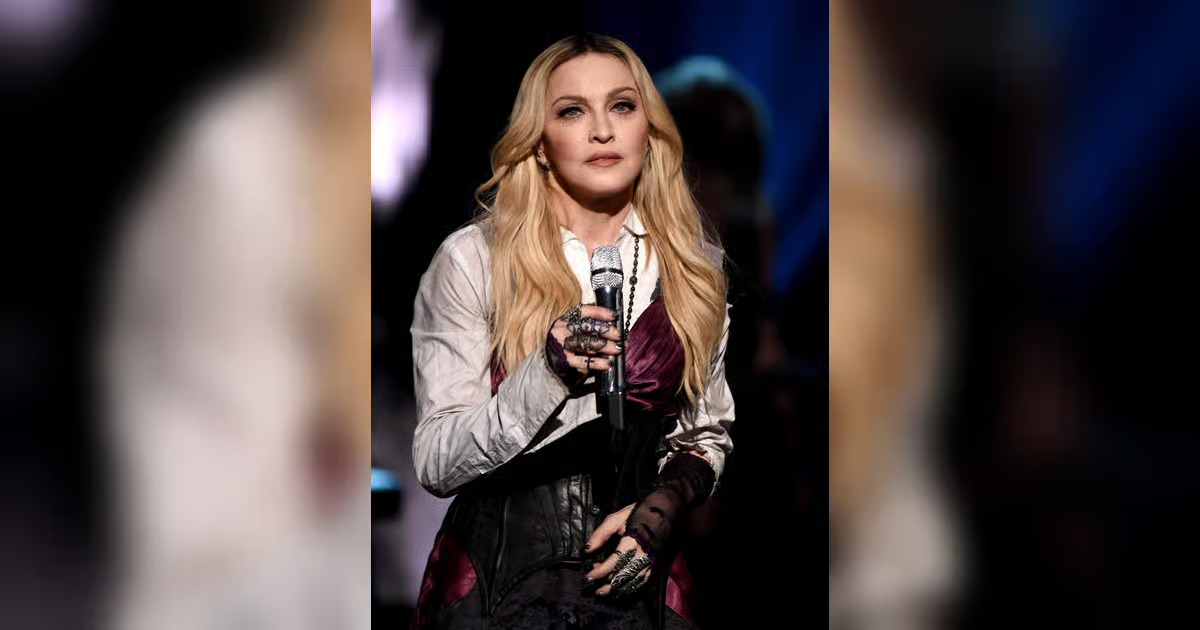
Madonna moved to New York City to be a dancer. Of course, her artistry blossomed into something much bigger. But she never stopped using dance to guide the way.
So much of Madonna’s performance universe has focused on reinvention — by way of hair and makeup, costume transformations, sets and settings. But what has endured is the grounded fluidity of her body. Her singing is galvanising, her activist voice is loud. Yet her body is the primary force behind it all: inexhaustibly alive, with a gallant, buoyant internal pulse.
Dance, her first love, is the most natural part of her artistry, her base, her place of worship. Watching her move without the music, you can see the suspension in her body, the ease at which she can shift her weight, the tautness of her muscular chain.
Her dancing, a choreographed tapestry of club, ballet, jazz and modern dance, is neither a tool nor an accessory. It is an unwavering force in her performing life. But Madonna, who turned 68 on Sunday, has never danced just for herself. She wants everyone to live by the emotional truth of dance: That has always been her most transparent dare.
The challenge started with the “Everybody” video (1982), shot at Paradise Garage in Manhattan. “Let your body take a ride / Feel the beat and step inside.” Alongside two dancers, she welcomes the crowd with outstretched arms and then raises them high as if to say it’s now or never, which means it’s now. Dance, to Madonna, is an invitation to shed your skin, to be born anew.
In her early videos, Madonna is upbeat, almost like the cheerleader she once was, as she glides from side to side and pops into the air. Her body often seems steered by the undercurrent of a bounce. As her shoulders twist and turn, her supple limbs send energy rippling through her body.
Dancing with her brother Christopher Ciccone and her friend Erika Belle in “Holiday,” that effortless bounce gives way to emotion in joyful, unselfconscious bodies.
Pop stars’ dancing isn’t an equal-opportunity experience. Some are trained and technically sound, some are dancing because it’s fashionable. But it’s not always a part of their being. Do they love it? Madonna does. In “Dress You Up,” an early performance with a sequence of spins, crossover hops and a darting leg extension, she throws herself into the choreography.
Growing up in Michigan, Madonna found escape and acceptance in dance studios, those often windowless sweat boxes that send the mind and the body searching and soaring. The lessons that her training in ballet and modern dance instilled are obvious: hard work, dedication, structure, perseverance. Even in a grainy clip from her college days, there is a decisiveness to her movement. Nothing is blurred.
Christopher Flynn, Madonna’s dance teacher and mentor, met her when she was young, with a doll tucked under her arm, and “just the most innocent child in the world,” Flynn, who died of AIDS in 1990, said in an interview on video. He spoke about how he liked her sense of fun “because it does not deny responsibility or deny seriousness or deny classicism, things that the love of what we were doing was all about.”
Her rigour took her briefly to the University of Michigan, though she dropped out to pursue a dance career in New York. In her early years, her dancing had a rawness, a steely commitment to modern dance’s interiority and tension. It’s not the kind of dancing she would show later in her videos and concerts, but there is the same forthright approach of dancing with faith.
After she landed in New York City, Madonna trained at Alvin Ailey American Dance Theater and the Martha Graham school, and performed with Graham veteran Pearl Lang. She also played drums in a band, started singing and found her path, but she never abandoned dance.
Twenty years after she parted ways with concert dance, she continued to trust dance to convey her feelings about the rights and wrongs of the world. In “Express Yourself,” her razor-sharp body becomes a vessel for a scream. (Graham could make her body scream, too.) Madonna’s pliés drop dangerously toward the floor. She rips apart her jacket to show her bra; she grabs her crotch. She is all angles as she devours the stage in this anthem of female sexual empowerment.
But she’s just as capable as playing a stripper with a heart of gold. In “Open Your Heart,” a tiny musical you can just about hold in the palm of your hand, full body shots show her natural coordination as her strident legs oppose the velvety épaulement of her upper body. This is a stripper with balletic line.
The sweetest spot of Madonna’s dancing, when experience and confidence united in dazzling ways, was when she was in her late 30s and 40s. “Ray of Light” introduced a new kind of sexy in which her clothing became more minimal (pants!), showing her body — and her movement — to greater effect. Though her dancing appears in between rapid-fire cuts, she shows a fresh virtuosity each time she comes into focus.
Walking along a projection of a dusty highway in “Don’t Tell Me,” Madonna dips her cowboy boot into a new dance rhythm: country. (She predates the current obsession for line dancing by a couple of decades.) Flicking up dry dirt with raised knees and gyrating her hips with a touch of modern-jazz that lends her dancing a knowing air, Madonna calls on the spirit of Agnes de Mille’s “Rodeo” and other Americana dances but gives them a novel groove.
As a video, “Beautiful Stranger” is less coherent and even a little crazy: It’s from an “Austin Powers” soundtrack. But ignore all that. The dancing is Madonna, just 40, at her most openhearted and free. She surges and undulates with athleticism yet maintains fluidity in rippling, exaggerated walks or low, slow descents into grand pliés. She’s a delight.
This is what Flynn admired about Madonna. “I like people who love to dance even more than want to be ballet dancers,” he said. At clubs, she would clear the floor. “Everybody loved her, and not because she was showing off,” he said. “It’s just that she so thoroughly enjoyed dancing that it just sprung out of her.”
In “Hung Up,” Madonna, then 47, wears a pink leotard while warming up and dancing in isolation in a paneled studio. She glides past a mirror, flicking her hips; she rolls her arms without an ounce of playfulness. She had just suffered injuries in a horseback riding accident, and seeing her body at work, pushing beyond what it thinks it can do, is enthralling in a true-to-life way.
But “Hung Up” makes space for other dancers as they spill out into the street or hurl their bodies into the air in a restaurant. In the end, Madonna joins the group outside. She’s glorious, this older, wiser Madonna, as she unleashes the dancing she was working on in the studio. It shows, intentionally or not, the difference between the toil of rehearsal and the ferocity of performance. We see what Flynn was talking about, the way dancing has a way of springing out of her, and it’s true of everyone around her, too.
This article originally appeared in The New York Times
Source: Khaleej Times
