


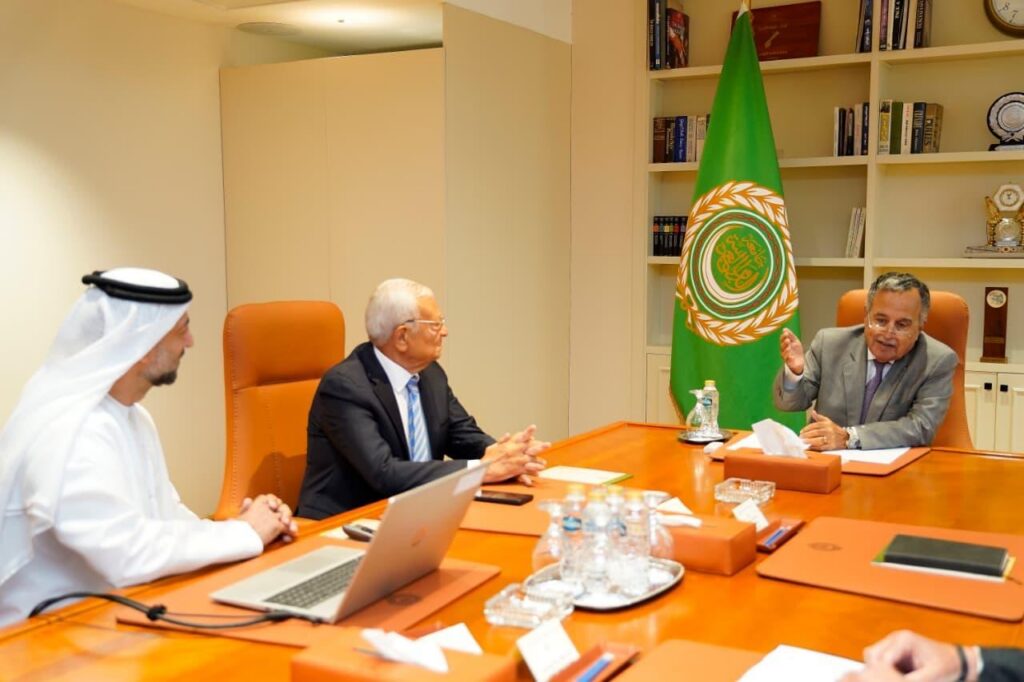
CAIRO, 23rd August, 2026 (WAM) — Nabil Fahmy, Secretary-General of the League of Arab States, discussed with leaders of the Arab Federation for Digital Economy the future of the Arab economy amid the rapid transformations driven by artificial intelligence and modern technologies, and the new requirements these developments place on Arab countries in growth, investment, technology production, the data economy and human capital development.
The discussions took place during a meeting at the headquarters of the General Secretariat of the League of Arab States in Cairo.
The meeting addressed the challenges and opportunities facing Arab economies in the coming period, the role of joint Arab action institutions in helping countries benefit from technological transformation, and a number of initiatives and projects being developed by the Arab Federation for Digital Economy.
The meeting highlighted the importance of developing more effective models for joint Arab action that bring together vision, policy, projects, investment and international partnerships, while enabling countries’ identified needs to be translated into practical, measurable initiatives.
Dr. Ali Mohammed Al Khouri, Chairman of the Board of Directors of the Arab Federation for Digital Economy, reviewed the Federation’s journey and its key initiatives and projects in digital economy, investment, food security, education and international cooperation.
He also outlined the Arab Digital Economy Vision and its development since its launch with support from the United Arab Emirates, including its strategic directions for building an Arab economy better equipped to benefit from digital transformation, technology and data, culminating in its adoption at the Arab Summit level.
Al Khouri also reviewed the Arab Digital Economy Index, developed by the Federation to measure the performance of Arab countries in digital economy fields, identify gaps and priorities, and provide a knowledge base to help governments and decision-makers direct policies and investments towards areas with the greatest impact on growth and competitiveness.
The presentation also covered a number of projects being developed by the Federation, including the Arab Food Market and the Mahaseel project in agricultural trade, value chains and food security, alongside digital education and training initiatives aimed at developing skills and linking them to labour market needs and the new economy.
The meeting also reviewed the Madar – Arab Platform for Digital Projects, which aims to provide a platform for showcasing projects and investment opportunities in Arab countries and connecting them with companies, investors and international institutions, helping attract capital, technology and global expertise to priority projects.
Al Khouri said the Federation is working to leverage its network of international relations and partnerships to open new channels for Arab countries to access investors, markets and global companies, while developing partnership and financing models that increase private-sector and foreign investment participation in development projects.
He added that the priority in the coming phase is to move from visions and initiatives to practical and measurable projects and partnerships, linking the digital economy more closely to growth, development and economic value creation across Arab countries.
The meeting, attended by Dr. Ayman Mokhtar Ghoneim, Assistant Secretary-General for Executive Affairs in the Federation, also featured extensive discussions on the transformations that artificial intelligence is expected to bring to the economy and society over the coming decades, and the need for early Arab preparedness for anticipated changes in labour markets, education, production, services, trade and investment.
Participants also discussed the importance of developing interoperability between Arab digital systems and platforms to enable greater cross-border exchange of data and services and support digital trade, digital services and economic integration among Arab countries.
Atef Helmy, President of the General Assembly of the Arab Federation for the Digital Economy, highlighted the importance of drawing on the expertise, initiatives and partnerships developed by the Federation over recent years and deploying them more broadly to serve Arab countries’ priorities within the framework of joint Arab action.
He said integration among Arab institutions is an important factor in accelerating project implementation and maximising available resources and expertise, particularly amid economic and technological transformations that require higher levels of coordination and joint institutional action.
Professor Dr. Ahmed Mustafa Al-Sherbini, Secretary-General of the Arab Federation for Digital Economy, said the next phase will focus on developing the Federation’s projects into programmes that can be scaled across the Arab region and linking initiatives more closely to countries’ economic and development needs and priorities, in coordination with relevant departments at the League of Arab States and partner institutions.
He noted that the success of digital initiatives depends on their ability to deliver measurable economic and social outcomes and create practical pathways that bring together governments, the private sector and international institutions around projects serving the region’s development objectives.
Source: Emirates News Agency
