


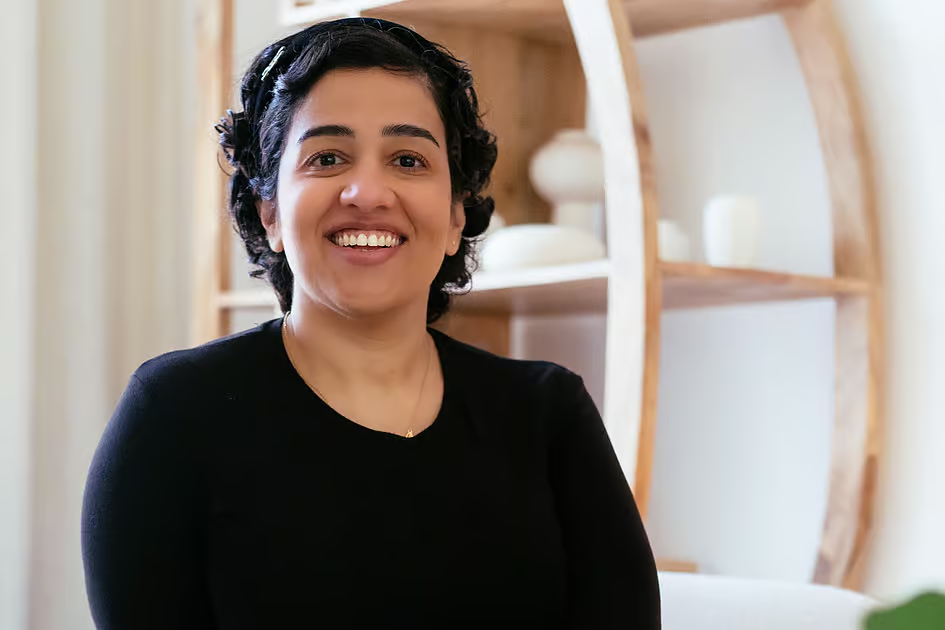
Before April 2024, Rucha Daryani’s days were filled with school runs, two young children and workshops for women trying to reconnect with themselves. At 38, she was building The Mum Identity Project and thinking about what she wanted to do next.
A stroke was nowhere in those plans.
“I had a clear sense of who I was and what I was doing, and I had never once considered that a stroke was something that could happen to me at 38,” she told Khaleej Times.
Daryani had gone to hospital because her ferritin, a measure of the body’s iron stores, was low. She said a doctor recommended an iron infusion, a treatment she had received before but had not tolerated well. She raised her concerns and explained that her previous infusions had been administered slowly. This one, she said, was given much faster.
Partway through, she felt something was wrong and sent her husband to find the doctor. “That’s the last thing I remember,” she said.
Her next memory is of waking in a neuro ICU. Her husband was asking whether she recognised him, whether she knew they had children and whether she could name them. She has no memory of the time between those moments.
In the weeks that followed, Daryani said she had little space to process what had happened. Her attention was on her children and the next task in front of her.
“There was no moment of taking it all in, no sitting with the enormity of what had happened. You don’t have room for that. You’re just surviving,” she said.
Her account raises a question she continues to think about: what happens when a woman says something is wrong with her body and feels she has not been heard?
Daryani said there was no formal review or investigation into her treatment. Her family decided against pursuing one while she was recovering and caring for two young children.
She does not name the hospital or doctor, and the circumstances leading to her stroke have not been independently established.
“I had a recovery ahead of me, two small children, and a finite amount of energy, and I had to choose where it went. I chose the rebuilding,” she said.
That experience has shaped The Second Act, a UAE-based initiative Daryani plans to launch publicly in October for women navigating major changes in their lives. Its focus extends beyond illness to experiences such as motherhood, divorce, burnout and career disruption.
For Daryani, recovery was about more than regaining physical abilities. It also meant facing the period after the immediate crisis, when she appeared well to others but was still adjusting to a life that had changed.
The Second Act grew from her belief that women need room to rebuild at their own pace, without being expected to return to who they were before.
“We celebrate survival, but often expect people to return to who they were before,” she said in background material shared with Khaleej Times. “You don’t go back, you build forward.”
Daryani is also preparing to release The Light Never Left, a children’s picture book inspired by her family’s experience of stroke and recovery. Both the book and The Second Act are expected to launch in October.
For now, she hopes her story opens a conversation about the part of recovery that is harder to see, and about listening when women speak up about their health.
“I said something was wrong and I wasn’t listened to,” she said. “That’s the piece I think is worth everyone’s attention.”
Source: Khaleej Times
