


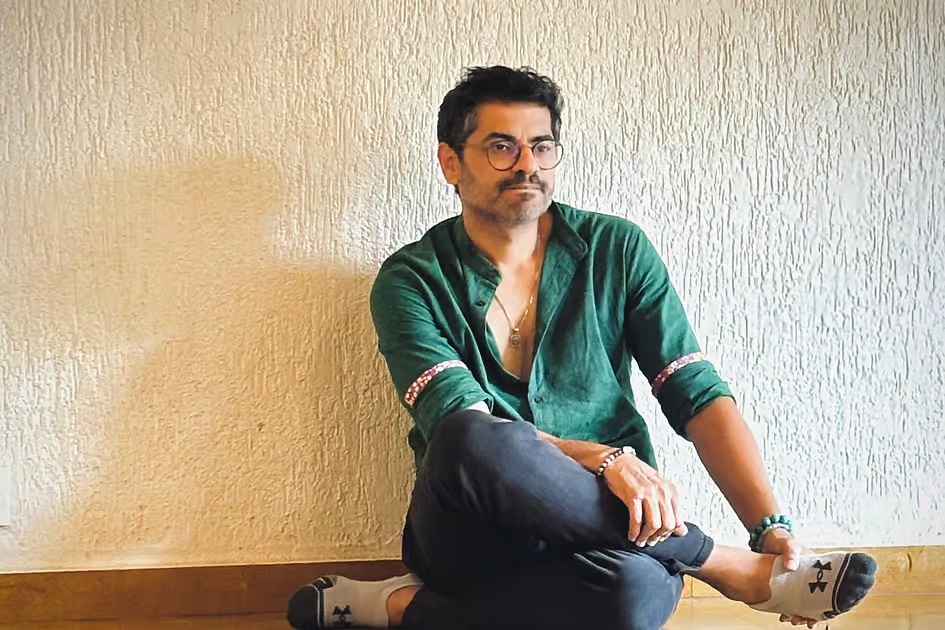
For most aspiring actors, learning the craft begins with understanding a script, memorising lines and figuring out how to convincingly become someone else. But for acting coach and filmmaker Atul Mongia, the process begins somewhere entirely different. With the self.
“First connect with yourself before you can even think of connecting with the character,” he says. “The characters will come through you. It’s not going to come from outside of you.”
It’s a philosophy that has shaped his approach to acting for over two decades, one that goes beyond the technicalities of performance to explore the psychological and emotional conditioning that often determines how freely an actor can express themselves.
The work begins within
Mongia’s own journey of introspection began long before he became an acting coach. At 19, he experienced what he describes as an internal shift that changed where he looked for answers.
“You know how at that age you usually look for everything outside. You look for answers outside. But I was only and only looking for the answers inside because I somehow understood that the answers were inside.”
Over time, this curiosity became central to his teaching philosophy. He began recognising that what appeared to be an acting limitation was often rooted in something much deeper.
“For example, when an actor is speaking, I might say, ‘You need to be louder.’ But me telling you that you need to be louder is not going to help. For it to actually happen, we need to go deep within and understand what it is within us that stops us from being louder.”
It’s why his workshops begin with dhyan, or meditation, rather than immediately jumping into performance exercises.
“Most actors are just trying to figure out how to say a line, how to express, how to emote,” he explains, pointing to the tendency to focus on facial expressions, voice projection and physicality before understanding the character’s internal world. “The reason people cannot tap into a space, the internal space of a character, is because they don’t even know how to tap into their own internal space. Forget a character’s internal space.”
Breathwork, he believes, offers a way to reconnect with that inner world. “The beauty of staying in awareness and being with your breath is that our gut and our instinct is always telling us what we need. We’re just not connecting with it. We’re just not listening.”
Why some emotions come easier than others
One of the most fascinating aspects of Mongia’s workshops is observing how differently participants access emotions. Happiness might come effortlessly to one person, while another may find anger or sadness easier to express.
According to Mongia, these differences are closely connected to our experiences and conditioning. Someone who has grown up in a secure, emotionally free environment, for instance, may find joy easier to access. Another person who has experienced emotional difficulties might instinctively understand hurt at a much deeper level.
But does that mean actors must master every emotion to become versatile performers? Not necessarily. “I always tell actors to start with your strength. First become good in your strength. Don’t panic or fret about, oh, I can’t do that. It’s okay.”
He points to performers who have built remarkable careers within particular emotional territories, arguing that depth can be just as valuable as range. “But whatever you think is your strength, be truthful and organic in your approach and explore the nuances within that strength.”
The power of doing nothing
Perhaps one of the greatest challenges for an actor is learning when not to perform. Think of the quiet moments that made actors such as Irrfan Khan or Nawazuddin Siddiqui so compelling on screen. Sometimes, their most powerful performances came from what they weren’t doing.
For Mongia, the ability to inhabit silence comes down to something surprisingly simple: being comfortable with yourself. “Firstly, if you’re doing anything from a space of fear, you’ll never be able to do it. I think art can only be created when it comes from a space of love, from a space of joy and not from a space of fear.”
He believes actors often overcompensate during quiet moments because they are preoccupied with whether their performance is working. “Only when we want to prove something, when we feel we are not good enough, do we try to compensate for who we are.”
Having coached some of the leading names in Bollywood and Indian cinema, Mongia has worked with actors at different stages of their careers, helping them discover the emotional and psychological nuances of their characters.
Speaking about the importance of stillness in a performance, he recalls working with Ahaan Panday for Saiyaara, whose natural personality was quite different from the character he was preparing to portray. “He’s a very good actor, so I don’t need to make him learn how to act. We all have our own rhythm and we all have our own way of being. And his natural being is positive, effervescent. He’s a little, not restless, but a little out there. Whereas the character [in Saiyaara] was very still,” he says. “The way he finally found him was through breathwork that we did.
When validation gets in the way
For an industry built around auditions, reviews, applause and rejection, separating personal worth from professional success can be particularly difficult. But Mongia challenges the assumption that seeking validation is simply an unavoidable part of being human. “Just because we have accepted that we all want validation doesn’t make it okay.”
The distinction, he explains, lies in whether feedback is received as an opportunity to improve or as a verdict on one’s worth. “Someone seeking validation wants their work to reflect their self-worth. Whereas someone who isn’t seeking validation will listen to feedback to understand what needs to improve, whether it’s their craft, their approach or something within themselves, without taking it personally.”
And the more an actor attaches their identity to their work, the harder it becomes to approach the craft freely. “See, the moment you attach your self-worth to something, you’re no longer doing it purely for the love of it. You’re actually doing it to prove yourself.”
His advice is to remove the ego from the equation. “Art was never about the artist ever. Take the artist out. Take your ego and your need for validation from it out. And just go and do your job. That’s it.”
It’s a philosophy he admits he continues to practise himself, particularly when it comes to filmmaking, where some attachment to professional identity remains.
Building an acting community in the UAE
Mongia’s most recent Dubai workshop, Acting and the Self, took place from September 4 to 9, marking his third workshop in the city.
His decision to bring the programme to Dubai was initially prompted by participants travelling from the UAE to Mumbai for training. “I do feel that in Dubai, there are not as many avenues for, say, theatre, art,” he says, comparing the opportunities with Mumbai.
But the response to his first workshop convinced him there was an appetite for something beyond conventional acting training. “People here had the need more than people in Mumbai, not just learning it as a craft but also just feeling some kind of connection with themselves.”
Now, he’s planning his first artists’ retreat in the UAE this December, a six-day immersive experience that could take place in Fujairah or another Emirate.
The idea is to give participants space to continue their introspective work away from everyday distractions, surrounded by nature and quietude.
Looking further ahead, Mongia hopes to establish a permanent training centre in Dubai, although he acknowledges that building a community takes time.
For aspiring actors waiting for more opportunities, however, his advice is straightforward. “Don’t wait for anybody to do anything. Just start. Even if it’s two people, start.”
Source: Khaleej Times
