


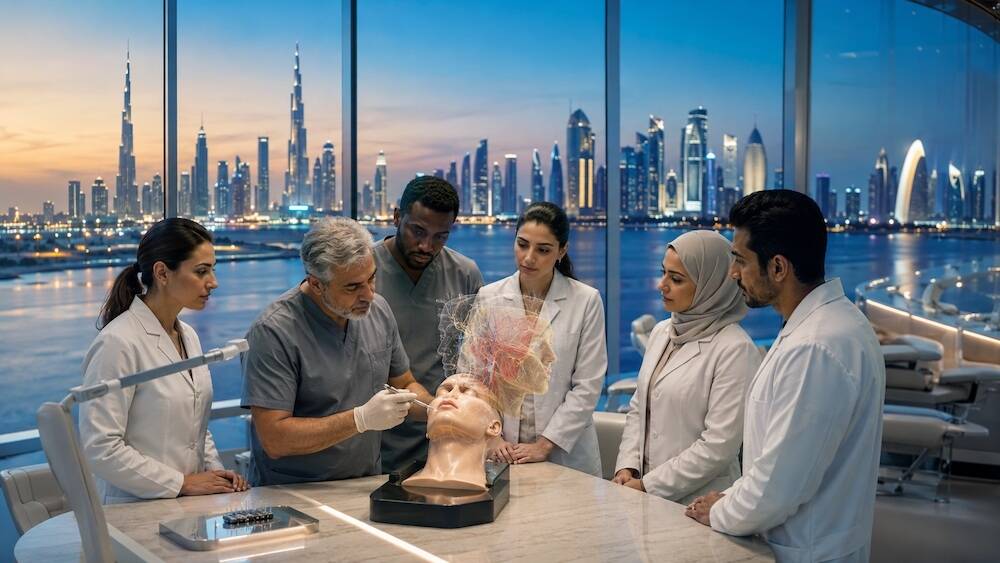
Aesthetic medicine in the Gulf is entering a more mature phase. After years of rapid growth in clinics, patient demand and non-surgical cosmetic procedures, attention is increasingly turning to an equally important part of the sector: how healthcare professionals are trained.
Across Dubai, Doha, Riyadh, Muscat and other Gulf cities, physicians, dentists, nurses and other eligible healthcare professionals are encountering a broader and more sophisticated range of aesthetic treatments. Learning individual techniques is only part of the challenge. Anatomy, patient assessment, treatment planning, complication prevention and clinical judgment are becoming increasingly important as the field evolves.
A Regional Market Entering Its Next Phase
The Gulf is not a single aesthetic medicine market. Dubai has become an internationally visible destination for aesthetic procedures, supported by a large private healthcare sector and international workforce. Doha continues to develop its healthcare and medical education ecosystem, while Saudi Arabia represents a large and rapidly evolving healthcare market.
Despite their differences, these markets share several trends. Patients have greater access to information, treatment trends can spread rapidly through social media, and practitioners are increasingly exposed to techniques and technologies developed internationally.
The challenge is that the popularity of a procedure can sometimes grow faster than the clinical competence required to deliver it appropriately.
This is one reason aesthetic medicine training in the GCC is increasingly moving beyond isolated demonstrations toward broader clinical education.
From Observation to Clinical Competence
Aesthetic procedures can appear relatively straightforward from the outside. Yet even a short injectable treatment may require an understanding of facial anatomy, vascular structures, product characteristics, injection depth, patient selection, contraindications and potential complications.
Technical ability cannot easily be separated from clinical judgment.
Online education has made medical knowledge considerably more accessible, allowing practitioners across the Gulf to study theory and observe techniques without travelling internationally. Procedural medicine, however, introduces an important limitation: watching a procedure is not necessarily equivalent to being prepared to perform it.
Supervised practical education can help address that gap. Hands-on aesthetic medicine training gives healthcare professionals opportunities to develop practical skills while applying anatomical and clinical knowledge in a supervised environment.
Rather than competing with each other, online and in-person education can serve different purposes. Theory can often be studied remotely, while procedural competencies may benefit from supervised practical experience.
From Dubai to Doha
Dubai’s international healthcare workforce gives the city a distinctive role in the regional aesthetics ecosystem. Practitioners trained under different medical systems frequently work within the same market, increasing both knowledge exchange and the need for shared frameworks around patient assessment, safety and complication management.
Its accessibility also allows healthcare professionals from neighboring countries to attend regional training without necessarily travelling to Europe or North America.
A similar development is visible in Qatar. As Doha’s healthcare and professional education ecosystem expands, practitioners increasingly have opportunities to access specialized training closer to where they work.
The Canadian Board of Aesthetic Medicine (CBAM), for example, has extended parts of its medical aesthetics education activities into the GCC, reflecting a broader trend in which international medical education organizations are increasingly delivering professional training within the region rather than requiring Gulf-based practitioners to travel abroad.
Saudi Arabia could further increase the scale of this shift as its healthcare sector continues to develop and demand for specialized professional education grows.
Training Is Expanding Beyond Traditional Injectables
The educational landscape is also changing because aesthetic medicine itself is becoming more diverse.
Injectable education remains important, but practitioner interest increasingly extends into regenerative approaches, PRP, skin rejuvenation, ultrasound and other technology-assisted procedures.
These developments make critical appraisal increasingly important. New treatments and products can gain attention before strong clinical consensus develops around their use. Future education therefore needs to address not only how procedures are performed, but also how practitioners evaluate evidence, select appropriate patients and recognize the limitations of emerging treatments.
Regional context matters as well. Clinical principles can travel internationally, but regulations often cannot. Scope of practice, licensing requirements and professional rules vary between jurisdictions, meaning practitioners remain responsible for understanding the requirements applicable where they practise.
Online Education Extends Access
Regional training centres improve access, but not every healthcare professional can regularly travel to Dubai, Doha or another major city.
Online education therefore has a complementary role. Foundational theory, treatment principles, anatomy reviews and patient assessment frameworks can be studied remotely, helping practitioners build knowledge regardless of location.
Healthcare professionals seeking flexible remote education can also explore online aesthetic medicine courses through CBAM’s international education platform and other medical education providers.
The important distinction is not simply whether education is online or in person, but whether the format is appropriate for the competency being taught.
A More Mature Market Requires More Mature Education
As aesthetic medicine across the Gulf becomes more sophisticated, professional education will need to evolve with it.
The strongest training models are likely to place greater emphasis on anatomy, clinical reasoning, evidence appraisal, patient selection, complication prevention and supervised practical experience rather than simply teaching popular techniques.
Dubai, Doha, Riyadh and other Gulf cities may develop at different speeds, but they are increasingly connected by practitioners, technologies and ideas.
The next phase of aesthetic medicine in the region may therefore be defined not only by the treatments available, but by the quality of the clinical education behind them.
