


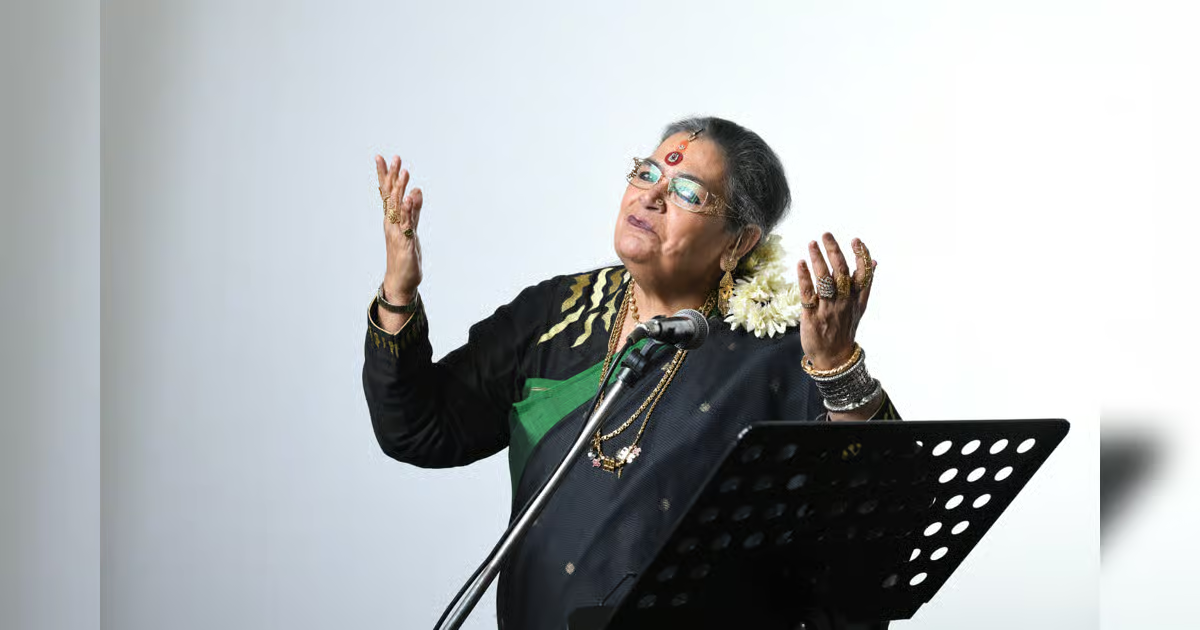
Catapulted into Gen-Z imagination following the popularity of a reworked version of Rambha Ho in Dhurandhar, Usha Uthup has been having a moment in the sun. Not that the legendary Indian singer needed any of this; Uthup, 78, is — and will always be — remembered for her unique voice that set a template for what was then considered “disco numbers” and essentially provided a counter to what one generally heard on radio or in films.
Underneath the easy labels, what the audiences then — and Gen-Z now — truly discovered is a voice that is unapologetically, unabashedly joyous. Very few performers are able to translate that sense of cheer into euphoria on stage the way Usha Uthup does. Her light-hearted interactions with the audiences and self-deprecating humour, combined with her obvious singing talent, make her one of the best live performers in India.
Come August 15, and Dubai residents can witness the phenomenon that is Usha Uthup for themselves as she performs at Thaalam Beats at Coca Cola Arena, along with Benny Dayal and the multi-genre band Thaikuddam Bridge. Ahead of her performance, Khaleej Times spoke with Uthup about her five-decade-long legacy and why the audiences cannot get enough of her, and she cannot get enough of them. Edited excerpts from an interview:
You are having a real moment with Gen-Z audiences right now with a rendition of Rambha Ho in Dhurandhar becoming hugely popular. As a result, the younger audiences are revisiting a lot of your older songs. How does it feel to carve such a timeless legacy?
I am absolutely thrilled. I have always believed that music, like life itself, is cyclic. Everything is just waiting for that little crack in the canvas for it to pop out. The funny thing about me has been that younger people would say my music is meant for older people, and the older people would say my music is meant for younger people. I have been singing now for 57 years, of which it’s already been 40 years since I sang Rambha Ho.
To think it would create such a storm — and I call it a storm because there are times when, during a show, I have to sing it twice — would be understatement. I cannot show enough gratitude to my audiences and, of course, to the filmmaker of Dhurandhar. It’s proven what I have said for so many years — you give some time to anything you create, and it becomes iconic over a period of time. People respond to originality, and the song is always bigger than the singer. I have always been 100 per cent original; I have never copied anybody. This new flush of happiness and togetherness and bonding with music has made me feel happy.
Your music was well-received even back in the day, but many did not know how to place it. Do you think the younger generation has a greater appetite for wide range of sounds?
At that time, I was an oddity. I didn’t start off as a playback singer; I was never in that race. I was performing at nightclubs and restaurants. It was only when people heard me sing live that I was given an opportunity to sing for a film. Everybody expects a woman’s voice to be high-pitched. And there I was with a completely different voice, some would even say it was a man’s voice. But I would not say people are more accepting now than they were back in the day. They accepted me, which is why I am where I am. People just loved my work and they loved the difference in my voice as compared to others.
Everybody expects a woman’s voice to be high-pitched. And there I was with a completely different voice, some would even say it was a man’s voice
Usha Uthup
You were also a woman who was way ahead of her time. Performing at nightclubs in India back in the day must have come with its own share of challenges.
I have always said that I have not learnt a note of music, so whatever I have has come to me through the experience of life. And what you learn in the school of life, you cannot learn in any other academic institution. I am not suggesting that youngsters should not learn music if they have an opportunity. But I have no regrets in not doing so because I would then have been cast in a mould, and then to do the kind of genres I do, which are so mixed, would have been difficult. The limitation of not having learnt music turned into strength.
You have been a livewire performer. The way you engage with the audiences is remarkable. How did that come to you?
The fact that from the first day on, I always felt that people loved the way I was always making jokes and being a comedian on stage. I was always being myself. I shared my funny takes on things. The way people applauded me became something I live for. I live for the stage; I live for the people. I have to have an audience. I am not one of those singers who can say, ‘I sing for myself.’ I must have the applause; it’s like having an intoxication which is hundred-fold more intense than anything else.
And what has been the most memorable moment from a live performance that remains etched in your mind?
There are just so many memories. One of the most amazing moments was when I recently did a concert called Anandam that had all bhajans. And people would think: what is Usha Uthup doing in a show like this? I sang Raghupati Raghav Raja Ram and received standing ovation. It was marvellous. Also, the memory of going back to Trincas in Park Street, Kolkata, and singing to a housefull of audience. Getting a full house is a huge pump of adrenaline for me. But I think one of the memories that stands out is one when I met Nelson Mandela. I also went to the Vatican and sang for Mother Teresa when she was canonised.
While your music is widely considered to be ‘modern’, you have always had a decidedly traditional look. Was it a conscious choice?
No. I was too little when I started. Also, I came from a middle-class family and wore what was available to me. But I was always well-turned-out. I was very good at stitching. If I had a yellow saree, I would see to it that I had a yellow clutch to accompany it. I still remain simple. Yes, I do wear a lot of kanjeevaram sarees that are expensive. But since Covid I have not bought myself a single saree.
What does it take to succeed when you don’t seemingly fit in?
You just bash on regardless. I told you this was my passion — to get the audience to laugh with me, pray with me, enjoy with me. These are things I always dreamt of, and I got them. Yes, maybe I did not get too many opportunities in playback singing with my voice being the way it was. But that didn’t matter. I am a happy person. I am very comfortable in my own skin. I don’t get frustrated if I don’t get to sing a song in a film. But hey, I have got Rambha Ho, I have done wonderful songs in different languages. I have no complaints.
Source: Khaleej Times
