


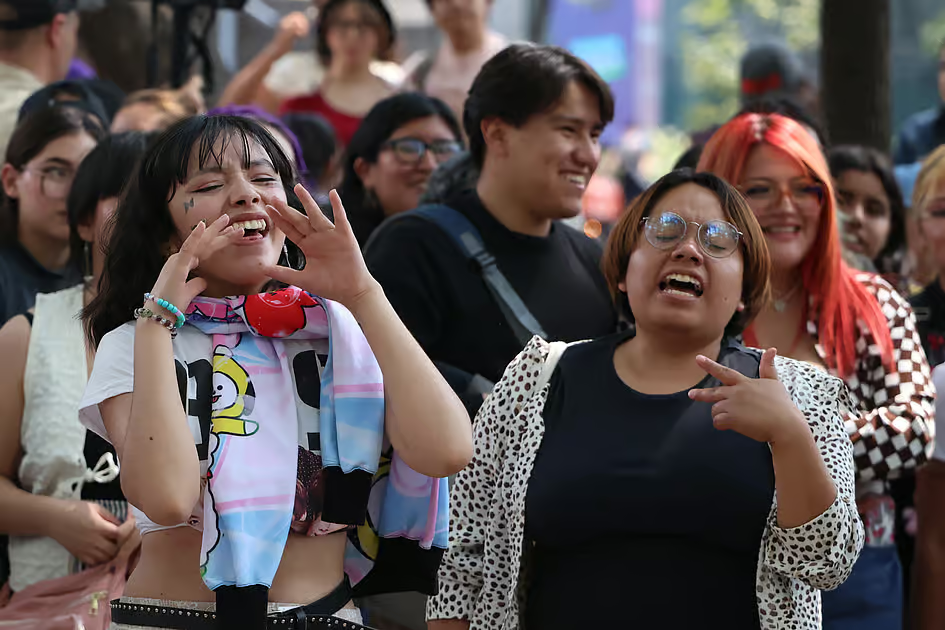
“I’ve had a lot of people try to tear me down,” a 23-year-old K-Pop fan in the UAE said, recalling when she shared an interaction she had with an idol at a concert on social media.
These people she said, insinuated that she “did specific things to get [the celebrity’s] attention” and managed to snag a meet-and-greet in a “corrupt way”.
Syrian expat Tala Niem, who calls herself a multi-stan (someone who supports multiple K-Pop groups), recalled this incident while speaking to Khaleej Times — though she was quick to clarify that “not all fans are like that.”
Stay up to date with the latest news. Follow KT on WhatsApp Channels.
K-Pop fan spaces host millions of people, with some of the biggest groups selling out concerts across the globe. The genre’s commercial reach has grown just as fast as its fan base: a 2024 Morgan Stanley report says that between 2019 and 2023, the combined revenue of the genre’s four largest Korean music agencies roughly tripled to nearly 4 trillion Korean won ($3 billion).
Cyberbullying in fan spaces
The industry’s meteoric rise has also brought in an exponential number of fans — not all of whom engage with it in healthy ways.
Some of these fans “hide behind fake names and usernames, so no one knows who they are” online, Niem said, giving them a degree of freedom to speak freely and without consequences.
“They come into this space where they can escape their world and escape their reality and let all of their emotions out there — especially the bad ones.”
Indian expat Syeda Nawab Fathima agreed. “A lot of discourse is happening online, [which] gives people a level of anonymity to say things that you might not in person”.
In extreme cases, that anonymity can have devastating consequences.
On August 5, the Yonhap News Agency reported that a Japanese influencer in her twenties had died at her residence in Seoul. Several online reports have identified her as ‘Mina Chan,’ a fan of the group Enhypen, though Yonhap’s original report did not name her or mention the K-Pop group.
About the alleged case
Mina Chan had reportedly been facing online harassment after Enhypen member Ni-Ki spoke about people who try to draw attention to themselves at the group’s events. He said live venues are places “where everyone can be happy” and that he found it “disappointing to see some people just want attention for themselves.”
Ni-ki, however, did not name anyone. Many fans, however, believed that he was speaking of Mina, who had recently shared pictures online from a fansign event in the US.
Mina then posted an apology on X in which she spoke about wanting to see Ni-ki and Sunoo (members on Enhypen) in person, adding, “By attending Enhypen’s fansigns multiple times, I had deluded myself into thinking I was closer to the members than I actually was. I deeply regret the rude behaviour I exhibited in America.”
According to local media reports, authorities responded after receiving reports that she was in danger during a livestream, and they later confirmed that she was no more. The case is under investigation by Seoul’s Yongsan Police Station.
In the aftermath, many K-pop fans have come forward to condemn the harassment she faced.
UAE expat Ruth D’Souza, who has been a multi-stan for over a decade, said that she felt “disappointment, devastation and fear” when she heard of Mina Chan’s case.
“Loving and cherishing an idol does not mean you can bully,” D’souza said, adding that fans in online spaces should know that “their words mean and hold value”. She urged fans to treat the idols and other fans “as humans”. “Yes, people make mistakes, they apologise. And then, life goes on.”
Tala, however, believes that those who bully others online in such spaces “may not be great people to begin with.”
Another K-pop fan, 24-year-old Sharjah resident PM, said that “Often, the idols themselves do not encourage bullying or online but their fans take it upon themselves to defend their idol.”
“It is a very one-sided relationship,” she added, highlighting how these fans build parasocial attachments with their idols.
Parasocial attachment
Tala, who first pointed out that “contrary to people’s belief”, not every fan has a parasocial relationship with their idol, said that some fans “believe that their idols owe them something and that [the idols] are theirs only to keep”.
She said they will “let go of their morals and ethics, and to be frank, their brain,” to defend their favourite artists.
Some fans build these one-sided relationships with idols, a dynamic often intensified by the industry’s emphasis on constant, intimate-feeling access through livestreams, fan calls, and social media that create an illusion of personal closeness.
Syeda emphasised that these fans think nobody knows their idols better than them because of the time “they spend obsessing over them”.
This dynamic can deepen fan loyalty and community, but it’s also been criticised for blurring boundaries between performers and audiences, sometimes fueling unrealistic expectations or unhealthy attachment on the fan’s side.
‘Being a fan should be fun!’
Still, fans are quick to stress that these darker moments don’t define the community as a whole.
Yan Hinolan, the admin of Bangtan UAE, a massive local BTS fanclub, said, “Being a fan should be fun!”
She emphasised on celebrating with the community, “As an admin of the Bangtan UAE fanbase with thousands of followers, I’ve never really had to deal with online bullies in our community. If anything, I’ve seen ARMY come together to support one another and celebrate BTS.”
She highlighted that her experience with the community proves that “online spaces don’t have to be toxic”, they can be places where “people connect, share joy, and feel like they belong.”
Ruth, too, believes these spaces “are supposed to be safe and welcoming,” where people come together to “cherish something of mutual interest.”
“Life’s too short for fan wars,” Yan concluded.
Source: Khaleej Times
