


DUBAI, 16th August, 2026 (WAM) — The 2025 performance results tracked by the 2026 Competitiveness Report reflect the growing reach of customs work in supporting UAE competitiveness, given the direct link between the efficiency of customs procedures and the pace of trade, the resilience of supply chains, the quality of government services, security, digital transformation, and the appeal of the business environment.
The report, which measures 2025 performance, drew on 30 global reports and 69 competitiveness indicators — including 10 new ones — offering a more comprehensive read on the performance of the country’s institutions and private sector, and the level of integration between government policy and operations.
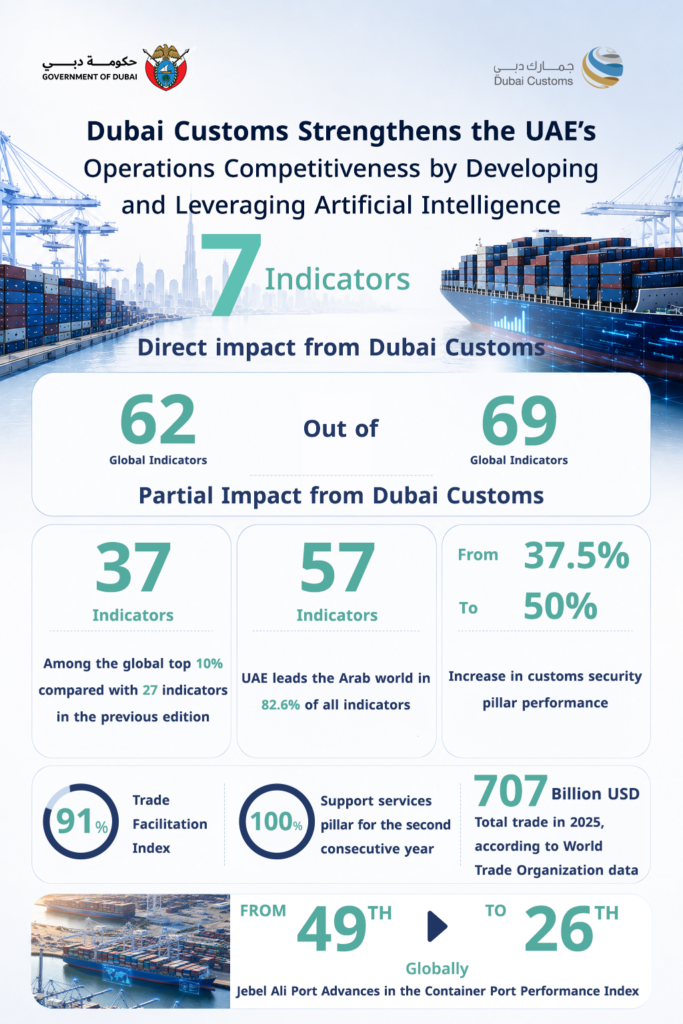
According to the results, the number of indicators in which the UAE ranks among the global top 10 percent climbed from 27 to 37 — a jump of 10 indicators in a single edition and the largest such leap on record. The number of indicators in which the UAE leads the Arab world rose from 47 to 57, or 82.6 percent of the total.
The UAE recorded nine upgrades into higher competitiveness tiers and improved its ranking within the same tier on seven more indicators, against a modest decline on only two. The share of indicators in which the UAE held or improved its leading position reached 87%, up from 84.7% the previous year.
Dubai Customs’ direct impact appears in seven competitiveness indicators tied to the core of customs work and the efficiency of trade movement — four of them within the World Bank’s Logistics Performance Index (international shipments, tracking and tracing, timeliness, and the customs sub-index), alongside the logistics services performance pillar within the Global Innovation Index, the border administration indicator within the Legatum Prosperity Index, and the customs and trade borders sub-index issued by the Transnational Alliance to Combat Illicit Trade (TRACIT).
The organisation’s influence also extends partially to 62 other indicators, reflecting how closely its operations are tied to the trade, logistics, digitalization, security, government services, and business-environment ecosystem.
This direct impact reflects the role customs operations play in determining how quickly shipments cross borders, how accurately they’re tracked, how reliably delivery deadlines are met, and how efficient clearance, risk management, and border oversight are — making Dubai Customs’ performance a driving factor in the efficiency of the UAE’s logistics and trade system and its ability to compete globally.
Dr. Abdulla Busenad, Director General of Dubai Customs, said: “Dubai Customs plays a pivotal role as one of the key enablers of trade and the economy, through an integrated operating framework that goes beyond traditional oversight of goods movement, contributing effectively to supporting the competitiveness of the national economy and accelerating its sustainable growth.
This is achieved through the development of customs operations, the streamlining of procedures, the smart use of data and artificial intelligence, strengthening the security and continuity of supply chains, and elevating the customer experience — converting operational efficiency into sustainable economic and competitive value.”
He added: “The competitiveness index results reflect the growing reach of customs work beyond the indicators directly tied to customs performance, underscoring the link between the efficiency of procedures and the pace of trade, the quality of services, the resilience of supply chains, the appeal of the business environment, and the economy’s capacity to adapt to rapid global shifts.”
The UAE ranked ninth globally in export trade for 2025, with total trade reaching $707 billion according to World Trade Organisation data. This coincided with Jebel Ali Port’s advance on the Container Port Performance Index (CPPI), climbing from 49th to 26th place globally.
These results reflect the importance of integration between ports, customs, and logistics: clearance speed, coordinated procedures, and precise risk management all help speed goods to market and raise supply chain efficiency.
In this context, Dubai Customs developed the “Shahin” platform to speed up clearance and shipping procedures, strengthen connectivity among relevant parties, cut transaction turnaround times, and improve the smooth movement of goods — supporting the flexibility of logistics operations and their ability to respond to change.
The UAE claimed the number one spot worldwide on the Absence of Bureaucracy index — a result that reflects a government approach that goes beyond moving procedures onto electronic channels, toward redesigning them, shortening their steps, and linking the underlying data and systems.
At Dubai Customs, that shift included moving from a model built on manual intervention to an integrated digital system grounded in automation, data analytics, AI, and proactive services.
The “Smart Risk Engine” is one application of this shift, using data analytics and AI to assess shipments, determine risk levels, and direct inspections with precision. The engine works in tandem with the “Advance Cargo Information (ACI)” initiative, which enables shipment data to be analyzed before it reaches port — supporting earlier decision-making, raising team readiness, reducing manual intervention, and directing resources toward higher-risk shipments.
The customs security pillar rose from 37.5% to 50% — a 12.5-percentage-point gain, the largest relative improvement among all the pillars covered in the report.
This improvement reflects the role of risk-based oversight in balancing security with trade facilitation, by reducing intervention in low-risk shipments and concentrating oversight resources on shipments that require closer inspection.
The “Green Corridor” also supports this direction by offering fast, secure pathways for compliant shipments, tying compliance to operational benefits, and directing inspections based on risk level — helping shorten clearance times, protect legitimate trade, and sustain supply chain continuity.
The Trade Facilitation index rose to 91.5%, while the Support Services pillar held steady at 100% for a second consecutive year, reflecting the impact of digital service development, a better customer experience, and more efficient communication channels.
Among the initiatives supporting this is the “Mirsal” platform, which has sped up responses to customer needs and inquiries and strengthened clarity around customs information and procedures, supporting companies’ ability to manage their operations and business decisions.
With the inclusion of the Global Talent index in the measurement framework, the concept of competitiveness now extends to institutions’ ability to develop talent and prepare it for the demands of the future economy. Dubai Customs continues to invest in national talent and future leadership through the “Masar 33” program, alongside specialized programs covering customs work, logistics, trade, and emerging technologies.
Dr. Abdulla Busenad affirmed that the competitiveness results represent an ongoing responsibility requiring continued capability-building, higher institutional readiness for the future, and investment in innovation, advanced technology, national talent, and strategic partnerships.
He said: “We will continue working to move from facilitating trade to empowering it, from delivering services to anticipating customer needs, and from managing risk to building a smart, agile customs system that supports sustainable economic growth and cements the UAE’s position as a leading global hub for business, logistics, and trade.”
The report’s results show that the impact of developing customs operations extends beyond operational performance indicators: faster procedures cut trade time, advance analysis raises port readiness, smart oversight protects supply chains, and improved services build trust within the business community — converting the efficiency of everyday work into economic value that supports the UAE’s competitiveness and sustainable growth.
Source: Emirates News Agency
