


For years, we’ve been told that doing something we love and making money from it are two very different things. That painting, writing, creating videos or pursuing a passion might make for a fulfilling hobby, but not necessarily a sustainable career. And for many aspiring entrepreneurs, that belief can become the very thing that stops them from turning an idea into a business.
But what if the problem isn’t the idea itself, but the way we’ve been taught to think about it? “I think a lot of people from a young age have been told a lie,” says British entrepreneur and content creator Simon Squibb. “There’s this perception that doing something you love is not a money-making one.”
Speaking to Khaleej Times in Dubai, Squibb explains that society has long drawn a distinction between what constitutes a serious career and what should remain a hobby.
Stay up to date with the latest news. Follow KT on WhatsApp Channels.
“We are told if you’re a kid and you’re painting, better get a real job now. You’re not going to make any money from painting,” he says, pointing to the success of street artist Banksy as an example of how unconventional passions can become commercially successful.
It is this very mindset that a new UAE initiative hopes to challenge.
Announced as part of the fifth edition of the 1 Billion Followers Summit, the ‘100 Dreams’ initiative will support 100 aspiring content creators and entrepreneurs in turning their ideas into sustainable businesses, offering each selected participant $10,000 (approximately Dh36,700), alongside six weeks of free business training and mentorship.
Launched in collaboration with Squibb and supported by the National Media Authority, the initiative forms part of the 1 Billion Followers Summit 2027, organised by the UAE Government Media Office under the theme ‘Content for Good’. The summit will take place from January 8 to 10, 2027.
From content creators to business owners
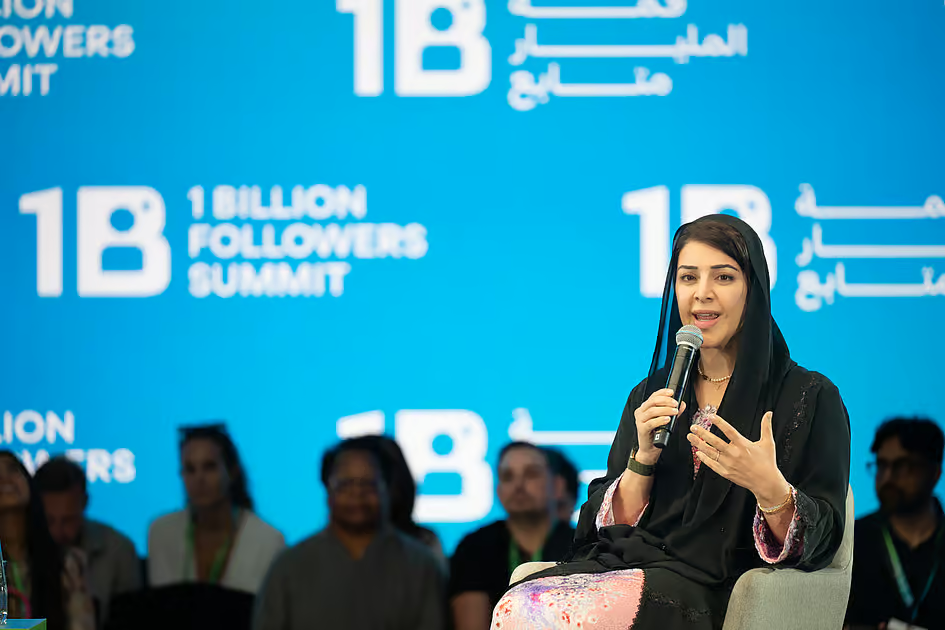
For Alia Al Hammadi, Vice Chairperson of the UAE Government Media Office and Deputy CEO of the 1 Billion Followers Summit, the initiative represents the next step in a conversation that has been taking place at the summit for several years.
“We always say that content creators can have their businesses. We always say content creators are the entrepreneurs of the future,” she tells Khaleej Times.
But the ambition extends beyond helping creators earn an income from their platforms. Al Hammadi believes that some of the next major companies in the media industry could emerge from ideas developed by content creators themselves.
“The future unicorn media would be one of the companies that those content creators established,” she says.
And the UAE, she believes, has the right environment to make that possible.
“We want content creators to have sustainable income. And UAE is the right place. UAE has the right infrastructure, UAE has the right talent, UAE has the right ecosystem for those content creators to flourish, to grow.”
Her long-term ambition is particularly striking.
“My dream is to see in 10 years from now, or maybe 15 years, one of those hundred dreams, one of those companies, becoming a unicorn,” she says.
What will the 100 selected creators receive?
While the $10,000 grant provides an initial financial boost, Squibb believes the real value of the initiative lies in the knowledge participants will gain.
The entrepreneur, who has built an online following of 27 million, says the six-week training programme will draw on his experience in building businesses, understanding social media algorithms and growing digital audiences.
“They’ll get six weeks’ intense support training on everything social media, everything business,” he says.
“We will help them and we’ll help them figure out how to make money from their platforms and how to take it to the level they want to take it to.”
The programme will cover practical aspects of entrepreneurship, from branding and sales to securing sponsorships and building a commercially viable business.
“Everything you need to have a successful business will be provided in their six-week free training plan,” Squibb adds.
Participants will also have opportunities to access the UAE’s business ecosystem, including potential residency and further support.
What will make an application stand out?
With potentially thousands of ideas expected, selecting just 100 will be no easy task. But for Squibb, evaluating a promising idea goes beyond financial projections.
“Purpose, energy, authenticity and capability. Those are the qualities we’re looking for,” he says. “Of course, there will be specific criteria around the application process and financial requirements. But having invested in 87 companies, I can usually recognise potential straight away.”
Al Hammadi adds that the selection process will consider the applicant’s needs and the uniqueness of their proposed business. “t depends on what is your need, it depends on the uniqueness of the idea.”
According to Al Hammadi, interested applicants can currently join a waiting list through the initiative’s website, with submissions expected to open by November 20.
Why the UAE?
For Maitha Al Suwaidi, Executive Director of Media Strategy and Policy at the National Media Authority, the initiative is also about creating the right conditions for ideas to develop into companies with long-term economic impact.
“The UAE is a land of dreams. It’s where talent becomes a business and a talented person becomes an entrepreneur,” she tells Khaleej Times.
She points to the country’s access to capital, digital infrastructure, technology and talent as factors that can help entrepreneurs take their ideas beyond the concept stage.
But what sets the initiative apart, she believes, is the accelerator programme that will accompany the financial support.
“What’s going to be different is the accelerator that those hundred companies will be put onto in collaboration with Simon Squibb,” she says, explaining that the entrepreneur will bring in his network of business, marketing and technology experts to support participants.
The National Media Authority, meanwhile, will focus on ensuring that businesses have the conditions they need to succeed.
“Our role as a National Media Authority is to make sure that we provide all of the conditions for those companies to succeed,” she says, highlighting partnerships, clear business processes and protection of intellectual property among the areas of support.
And while the initiative will be a major part of the upcoming summit, Al Suwaidi believes its real impact will only become evident years later.
“Success won’t be measured in January. Success will be measured in years to come, when we see the number of jobs that were created, the families that were supported, the brands that come alive because of this support,” she adds.
‘Nobody is entirely self-made’
For Squibb, the initiative also carries a personal significance. Having started his first business at just 15, he remembers what it was like to have an idea without necessarily knowing how to build it into something bigger.
“I didn’t know what I didn’t know,” he recalls, explaining that much of his early entrepreneurial journey involved figuring things out on his own.
Now, through the initiative, he hopes to give aspiring entrepreneurs access to the resources he wishes he had received at that age.
“We want to provide knowledge, capital, support and community, all the things I wish I had access to when I was 15.”
And his most important message to aspiring creators is that asking for help should never be seen as a weakness. “Because nobody is entirely self-made. Everyone needs help along the way,” he says.
For the 100 creators eventually selected, that help could be the beginning of something much bigger than a successful social media account. It could be the first step towards building a business of their own.
Source: Khaleej Times
