


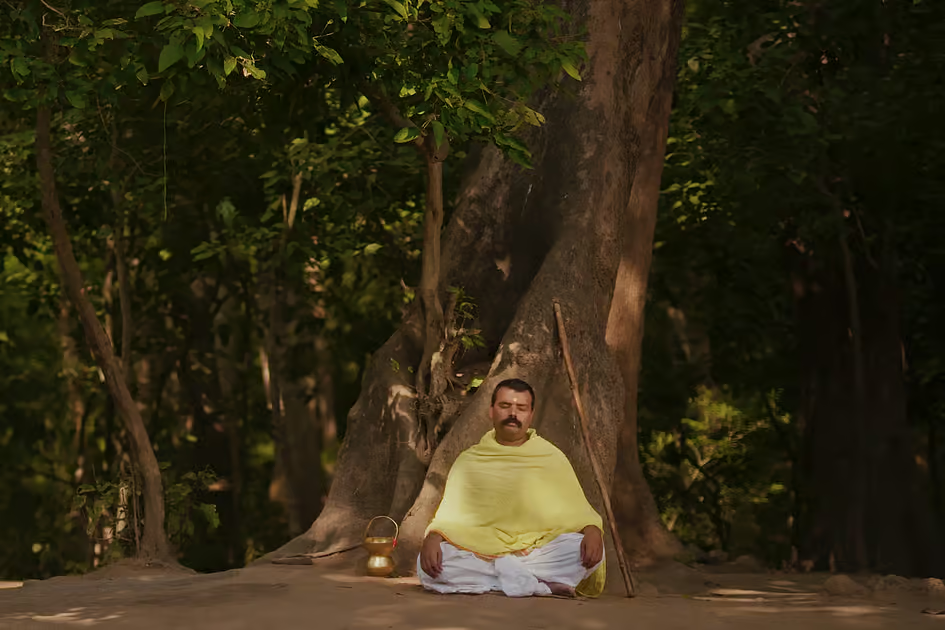
There is a moment in Hanuman Ansh when a door opens and Neem Karoli Baba, or Maharaj Ji as he is known to millions of devotees around the world, first appears. In the background, Krishna Das’s rendition of Om Namah Shivaya begins to play.
For producer Namrata G Singh, that choice is far more personal than audiences might realise. In 2011, after losing her father, Singh found herself at one of the darkest points of her life. It was around then that the music of American kirtan singer Krishna Das entered her world, and through him, so did Maharaj Ji.
“When my father passed away in 2011, I tried to take my own life,” Singh tells Khaleej Times. “That was the time when Krishna Das came into my life. I spent five years with Krishna Das and was part of his first concert in Bombay.”
Years later, when she was producing a film about the childhood of the spiritual teacher whose presence had organically become part of her own life, Krishna Das would contribute Om Namah Shivaya to its soundtrack. “When I heard Krishna speak about Maharaj Ji, he spoke about how flawed he was and despite that, how much Maharaj Ji loved him,” she says. “I needed that.”
A film rooted in personal faith
Written and directed by Vishal Chaturvedi, Hanuman Ansh traces the early life of Neem Karoli Baba, following a grieving child whose search for his mother eventually becomes a much larger spiritual search.
Much of the film was shot in Parsonja in Chitrakoot, a location the makers felt came closest to the period they were attempting to recreate. Part of that decision was financial. The independent production simply did not have the money to manufacture an entire world through visual effects.
But Singh believes that constraint ultimately worked in the film’s favour. “Even if we had the money, we would shoot in real locations because we had to transfer empathy and emotions,” she says. “Emotion and empathy transfer happens best in live action and in real locations without artificial occurrences.”
CGI was instead reserved for things they simply could not recreate, including a steam engine and certain other sequences. “I think that is the purpose of CGI, where you create something that you cannot create in reality, not just replace reality altogether.”
That pursuit of authenticity extended to the faces inhabiting this world. Instead of building the film around a conventional star, Hanuman Ansh largely relies on lesser-known actors, with villagers from locations where the team filmed also appearing on screen.
Even its lead got cast unexpectedly. Shobinaw Satyaa, who plays Maharaj Ji, was originally working behind the scenes on the production and stepped into the role after the original actor fell ill.
For Singh, however, the film’s endeavor for authenticity began long before its locations or casting. Chaturvedi has been a devotee of Maharaj Ji for around two decades, while Singh says her own relationship stretches back 14 years. “There is no book that we haven’t read,” she says. “We knew all the stories. It was just about putting them together in a cinematic format, with a storytelling that appeals to you, with a vein to it, with a heart to it.”
At the centre of that storytelling is the Hanuman Chalisa. Singh says eight of the stories incorporated into the narrative work as a “decode” of the devotional hymn, while the incidents depicted are drawn from accounts of Maharaj Ji’s life. “The soul is the Hanuman Chalisa,” she says.
Yet she is reluctant to describe Hanuman Ansh as a film about miracles. Instead, she points to the constant intersection between faith and reason within the story, including its sutradhar (storyteller), a doctor who begins as an atheist before becoming a devotee.
“We have tried not to have miracles in the story,” Singh says. “At every point, there is science and faith going together. There is an evidence-based and faith-based intersection happening all the time.”
The larger question, she says, remains far simpler. “The whole point of telling this story was that this is a child’s journey who has lost his mother,” she says. “Why do you only aspire to be a CEO or a footballer or an influencer? Can you aspire to be something deeper? Can you do something for society? If that happens, then this is a story well told.”
It is also an idea Singh believes has become increasingly disconnected from everyday life. Spirituality, she argues, should not be something reserved for old age, rituals or a few minutes of meditation.
“We are spiritual beings having a human experience,” she says. “The sooner you’re reminded of that, the better. Spirituality is everyday life. It’s not something you do five minutes a day, or 10 minutes a day, or through five rituals or 20 temples. It is part of who you are.”
When ‘everybody said no’
Getting that philosophy onto a cinema screen, however, required a considerably more earthly struggle. Singh and Chaturvedi founded Swambhu Media Network in July 2025 and began looking for backing for the film. “Everybody first said no,” she adds. So, eventually, they decided to make the film themselves.
According to Singh, the initial production required roughly Rs1 crore. Producer Ragini Sona agreed to contribute half if another producer came aboard. When they could not find one, Singh put in the other Rs50 lakh herself. More funding arrived during post-production, followed later by support for promotion and theatrical release.
“I was scared, but I was committed,” Singh says. “Once you’ve committed and you’ve started something, you have to finish it. That’s the entrepreneur’s version of reality.”
There was no enormous marketing campaign waiting at the other end either. The makers, Singh says, had hoped that perhaps 50,000 people would watch the film early enough to trigger word of mouth. But only around 35,000 did in its first two weeks. Then, slowly, something shifted.
“Somehow, in the second week, the word of mouth picked up,” she says. “Then India took over. The audience took over. Now we are just a case study of what audience love and word of mouth looks like. It is not us. We have done nothing. It’s the audience.”
What comes next for ‘Hanuman Ansh’
The film has since travelled internationally, while Singh’s attention has already moved towards dubbing it into more languages, expanding its accessibility and developing new formats around the property.
Among them is Chalisa Kavach, a chant-and-repeat game designed to help younger audiences learn to recite the Hanuman Chalisa. A potential continuation of Hanuman Ansh is also being considered, although Singh says serious conversations will only begin once the work surrounding the first film settles.
If it happens, the ambition is eventually to tell Maharaj Ji’s story across three parts: his childhood, Kainchi Dham and his international legacy.
Having struggled to find a route to distribution, the team is now attempting to create one for other independent filmmakers through Ticket to Balcony, an initiative aimed at helping completed, unreleased films find audiences through digital platforms and, where possible, theatres.
“What others didn’t solve for me, I want to solve for others,” she says. “Let’s solve problems at scale for everybody who comes after us. They shouldn’t go through what we went through. We shouldn’t have to go and beg or feel smaller just because we have lesser budgets.”
It’s a fitting philosophy for a film that, by Singh’s own telling, was built largely on what it did not have: no major star to sell it, no giant marketing machinery, no unlimited budget and no appetite for manufacturing grandeur where reality could do the job better. However, what it did have was conviction. “Trust yourself. Trust your story,” Singh says. “That’s all that there is.”
Source: Khaleej Times
