


One of the first things you notice when you step into the King Abdullah Financial District (KAFD) arrival plaza in Riyadh is a tree. This is no ordinary tree. Fashioned out of stainless steel and everyday household utensils, it’s a life-sized sculpture called Family Tree (2020). Anyone familiar with the Indian artist Subodh Gupta’s trailblazing art will instantly recognise his distinctive signature in this work. Dubbed India’s ‘Damien Hirst,’ Gupta is known for transforming humble household objects — most famously, steel tiffin lunch boxes, steel dinner plates, kitchen pans, and even bicycles — into blue-chip art pieces.
Beyond its tangible beauty, the sculpture, which is shaped like a peepal, or bodhi tree, carries a profound cultural and spiritual connotation for millions of the South Asian diaspora who live in Saudi Arabia and neighboring Gulf countries. “Family Tree reflects the power of art to connect people through familiar materials and shared experiences,” explains Bader AlShenaifi, a senior director of Riyadh Art, noting that this work is part of a larger state vision for public art in Saudi Arabia — to offer local and international visitors alike an art-rich, visually-stimulating urban experience. Led by the Royal Commission for Riyadh City, Riyadh Art is one of the world’s largest public art programmes and one of Riyadh’s four original mega projects under Vision 2030.
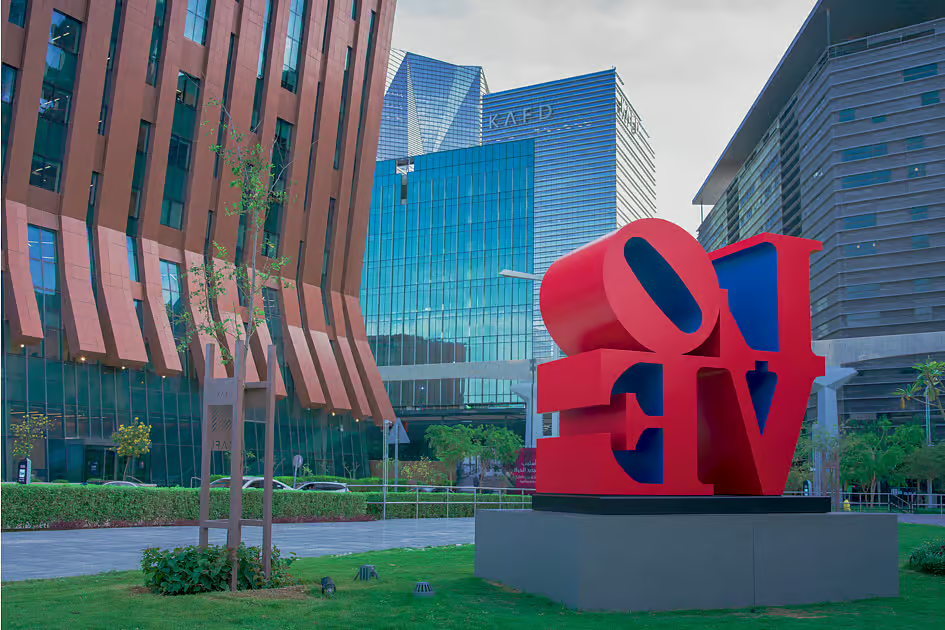
Gupta’s glittering work has joined Riyadh Art’s staggering permanent collection, which includes monumental offerings by such world-renowned artists as Anish Kapoor, Jeff Koons, Anselm Kiefer, Alexander Calder, Robert Indiana, El Anatsui and many more. While Anish Kapoor’s breathtaking Sky Mirror, Blue sits at the Al Kindi Plaza, twisting the skyline around it and urging us not to fall for the subjective nature of perception as reality itself may be a construct, Alexander Calder’s colourful and kinetic Janey Waney greets visitors at the King Abdullah Financial District (KAFD) Metro Station as part of Riyadh Art’s initiative. Nearby stands the American artist Robert Indiana’s iconic LOVE (Red Outside, Blue Inside) sculpture. In total, Riyadh Art has installed around 75 such artworks since its high-profile launch in 2019. Most of these works are publicly accessible.
As Saudi Arabia reshapes its cultural landscape, a remarkable public experiment like Riyadh Art is serving as one of the canvases for that transformation. For Bader AlShenaifi, who’s also an accomplished architect, the scale of Riyadh Art’s achievements is significant. He proudly points out that Riyadh Art has brought together more than 500 artists representing over 75 nationalities. “But ambition, in our context, is less about numbers and more about long-term impact. We are not simply installing artworks across a city. We are contributing to how Riyadh evolves as a place where culture is experienced as part of everyday life,” he insists, adding, “Ultimately, our ambition will be measured not only by what we deliver, but by the lasting relationships people develop with the artworks, the places around them and the city itself.”
Meanwhile, Riyadh Art is not the only leading force redefining the Saudi skyline. The Kingdom’s cultural landscape has undergone a radical transformation in the last decade, driven by a young population, creative professionals and a visionary leadership. As Saudi Arabia increasingly looks towards diversifying its economy under the stewardship of its young Crown Prince and Prime Minister Mohammed bin Salman, there’s a palpable sense of buoyancy you can’t miss while driving through Riyadh, Dammam, or Jeddah these days, where art has transitioned from a private pursuit to a spectacularly public movement.
From the Diriyah Contemporary Art Biennale in the JAX district to the Islamic Art Biennale in Jeddah, young Saudi art enthusiasts are now at the forefront of the Kingdom’s creative narrative. Among outdoor festivals, Desert X AlUla has already made a huge mark, welcoming visitors from all over the world. With its natural settings and artistic activities, the dramatic rocky terrain of AlUla has itself become an important stop in the art world’s cultural calendar.
The evolution extends all the way to Dhahran, where the pebble-shaped Ithra building stands as a first-of-its-kind hub for art, creativity, and learning, standing tall near the site of Saudi Arabia’s first oil discovery. With two of Riyadh Art’s flagship annual events — the Noor Riyadh light art festival and the Tuwaiq Sculpture Symposium and Exhibition — drawing audiences from Saudi Arabia and around the world, the logic is clear: becoming a global hub for ideas requires more than just hotels. It requires stories, artists, and meaningful places to gather.
“What we are witnessing in Saudi today is an extraordinary cultural transformation, supported by a clear commitment to creativity, cultural participation, and investment in people. Across the Kingdom, new initiatives, institutions, and opportunities are creating greater visibility for Arab culture while opening new forms of exchange with the international creative community,” explains AlShenaifi, adding that the opportunities created in the creative industries are not only empowering Gulf artists but also women artists. Platforming Saudi and regional artistic practice is central to Riyadh Art, he admits. This is reflected in the artists represented through the programme. The numbers speak for themselves. Of the 127 Saudi and GCC artists represented through Riyadh Art, 55 are women, accounting for 43.3 per cent of that artist base. “For us,” AlShenaifi concludes, “it is important that the programme continues to create meaningful opportunities for artists from Saudi Arabia and the GCC region, while representing different voices, generations, and artistic practices.”
Source: Khaleej Times
